Sunday, February 4, 2024

Rent or Buy? Good, Better & Best Violins, Violas & Cellos

By Andy Fein, Luthier at Fein Violins


Parents of budding musicians always seem to get to a certain point- "My kid needs a better instrument, but I'm not sure they're going to stick with it".  Or, "Their teacher says they need an instrument in the $ 3,000 to $ 20,000 range (or more!). Yikes! My blood pressure just spiked!"                             

Cool down, we have a solution for you! You can rent better-quality instruments from us! All the way up to more than $100,000. Rent one for months or years, or just for a big recital or audition. These instruments are available in full size (4/4) and 7/8 size. 

Sunday, October 15, 2023

Women Composers- Alive & Composing. Give Them a Listen!

By Andy Fein, Luthier at Fein Violins; and El Show & Jennifer Lee


Today, right now, this time in history is (in our humble opinion) the best time ever to be a female composer. Given all the ways to get your music heard- live performance, social media, games, movies, and streaming, a composer has infinitely more venues to share their creativity compared to composers even fifty years ago. 
Here are some women composers we think you should listen to. If you like them, share them with your friends!


Hildur Guðnadóttir 

Hildur Guðnadóttir
Hildur Guðnadóttir photographed by Timothée Lambrecq via billboard.com

Let's start with someone you may've heard the music of, even if you aren't constantly listening to the classical radio: Hildur Guðnadóttir. Composer of the score to Todd Phillips' Joker (2019), her work for the movie won her the Oscar for Best Score (1). She is one of three women to have won the award by themselves (1). Being a cello player herself, the score began to be composed by Guðnadóttir playing around on her halldorophone: an acoustic-electric cello, which lends itself well to "droning feedback" (2). 

Excerpt from "Composition for Halldorophone #5"

Born in Reykjavík, Iceland in 1982, Guðnadóttir played cello from a young age and joined the Reykjavík Music Academy. She studied composition and new media at Iceland Academy of the Arts and Berlin University of the Arts, and is now currently based in Berlin (3).
 
Alongside winning an Oscar for her film score, she won an Emmy for her score for the 2019 min-series on HBO, Chernobyl (3). As well as composing for theatre and dance, she has also released solo albums -- four in fact! She has her own website for more information and direct links to a lot of her music. 


Valerie Coleman

Valerie Coleman via The Manhattan School of Music

Our next composer has many accomplishments, including making history as a Black woman in the performing arts and founding a quartet highlighted in the Smithsonian Museum. 

Valerie Coleman is both a flautist and composer, and she was the first living Black woman composer to have a piece performed by the Philadelphia Orchestra (4). The piece played was her orchestral arrangement of her own work titled Umoja, which the orchestra played at Carnegie Hall (4). 

Minnesota Orchestra: Valerie Coleman—Umoja, Anthem of Unity for Orchestra


In 1997, Coleman founded a wind quartet based in New York City called Imani Winds. The quartet has a "permanent presence in the classical music section of the Smithsonian National Museum of African American History and Culture in Washington DC" (5).

Another interesting piece of hers is called "Shotgun Houses for Clarinet and Strings" (6). Coleman was born in Louisville, Kentucky, and the neighborhood she grew up in was also home to Muhammad Ali. "Shotgun Houses" chronicles his life, told through three movements (7). Anthony McGill, principal clarinetist for the New York Philharmonic, describes the work as "At times, we’re in a ring with Muhammad Ali, fighting and going through each ring and all the batting that goes back and forth, the strategy, the percussive rhythms" (6). 

Valereie Coleman will be an artistic partner with the St.Paul Chamber Orchestra during the 2024-25 season. We're looking forward to the collaboration!

Currently, Coleman also works at the Manhattan School of Music in many fields, including Composition and Orchestral Performance. For more information on Coleman and her projects, check out her website!


Gabriela Lena Frank

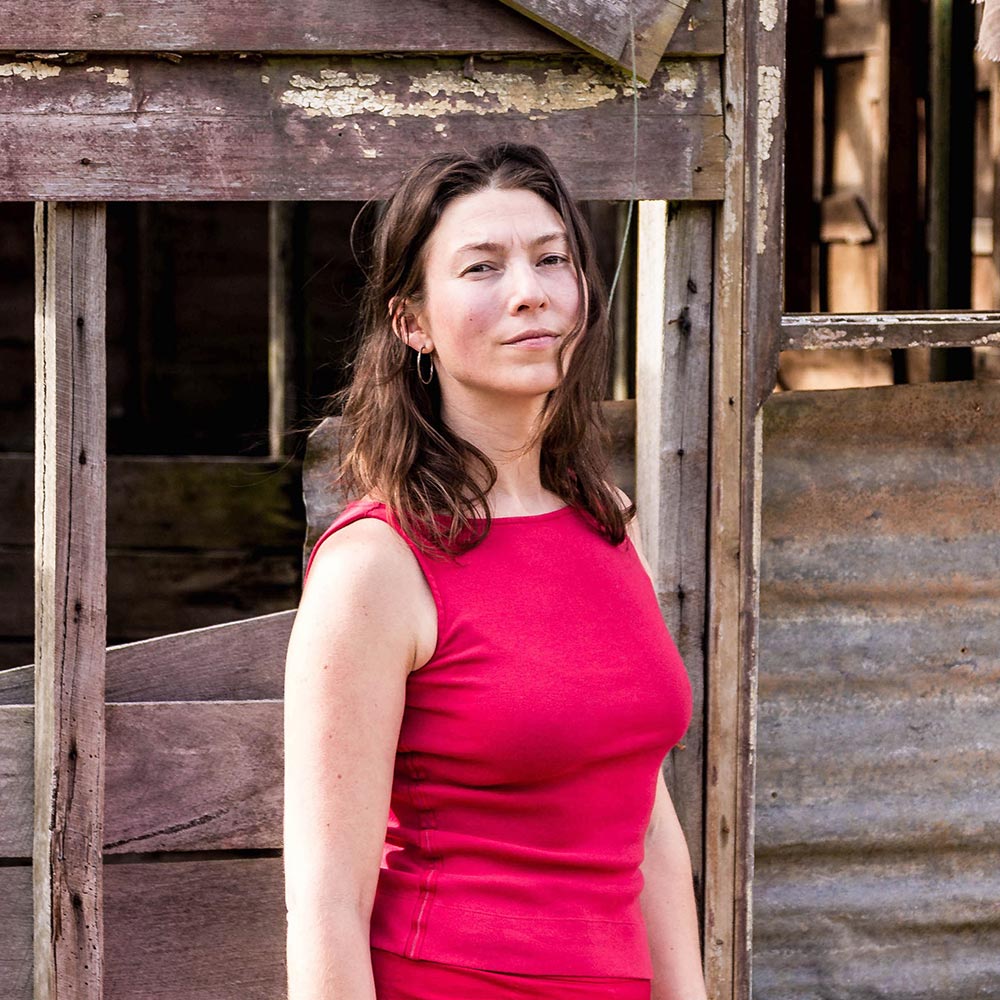
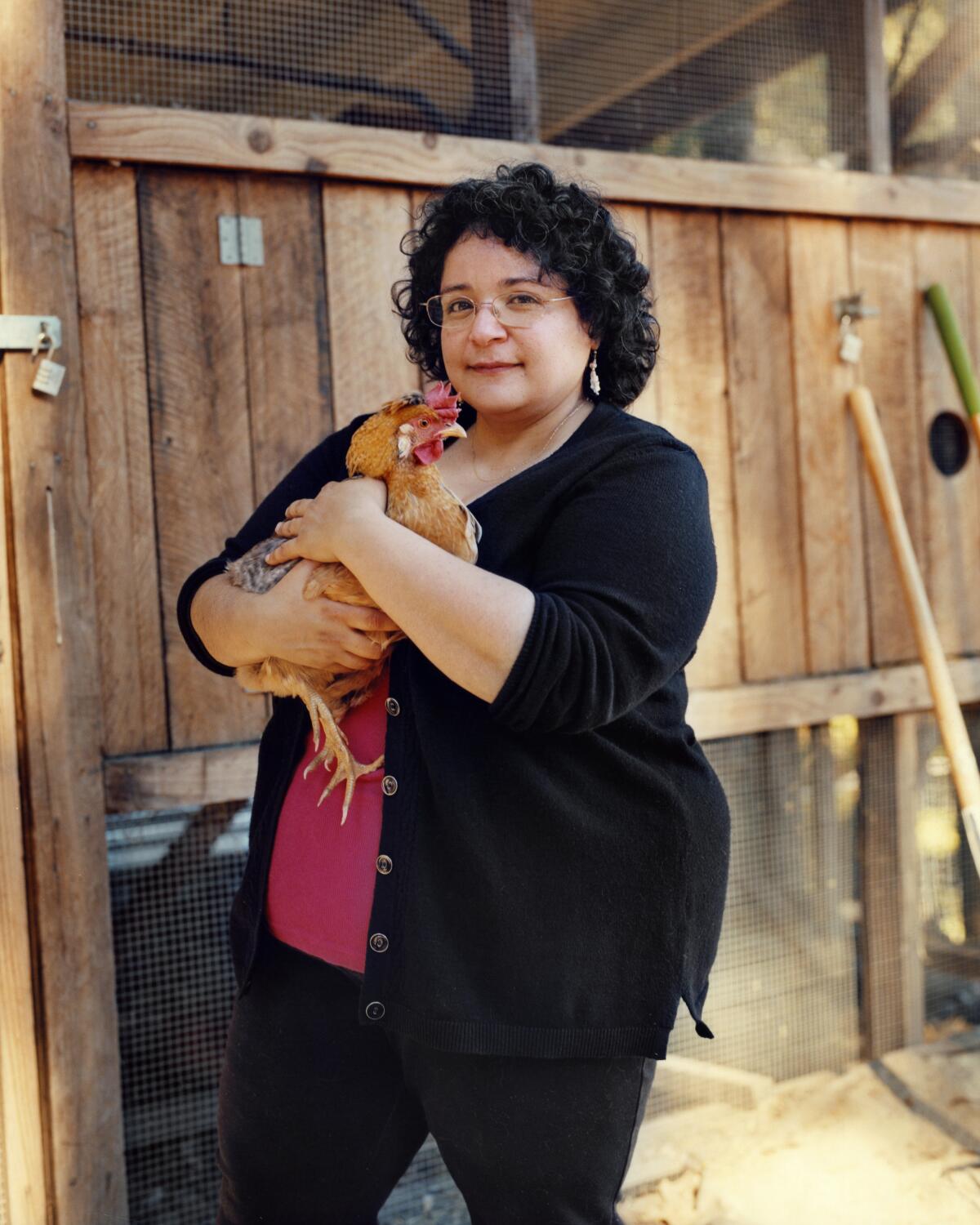
Composer Gabriela Lena Frank finds working on her farm can inspire her creative impulse to write music.
Lena Frank by Carlos Chavarria via The New York Times

Gabriela Lena Frank is a woman of many facets (Peruvian of Chinese descent on her mother's side,  Lithuanian Jewish on her father's) and she brings all aspects of her identity to her music. She is hearing impaired and has worn hearing aids since age 5, and is also blind in one eye (9). But this obviously wasn't going to stop her from making music, and Lena Frank composes all of her music in her head rather than at an instrument (9). Impressive!

Her mother is Peruvian, and she likes to draw on this part of her heritage in her music (11). She has traveled widely in South America, and her work combines the "poetry, mythology, and native musical styles into a western classical framework that is uniquely her own" (12).

In 2009, Lena Frank won the Latin Grammy for best Contemporary Classical Music Composition for her work "Inca Dances" (10, 12). Also in 2009, she was awarded a Guggenheim Fellowship for Music Composition (10).

Inca Dances: Danza Del Mallqui-rey

Another inspiration for Lena Frank is Bartók. She's inspired by his appreciation for folk melodies, and says, "It’s like a call to arms, this goal of using simple means to convey something that is authentic from the people" (9).

Lena Frank founded the Gabriela Lena Frank Creative Academy of Music in 2017, which is a non-profit "training institute" for future composers. 
Currently, she is the composer-in-residence for the Detroit Orchestra, and has been since 2013-2014 (13).

Lena Frank is also an Artistic Partner with the St. Paul Chamber Orchestra this 2023-2024 season!


Arlene Sierra

Arlene Sierra

Arlene Sierra is an American composer currently based in London (14). She studied at Oberlin Conservatory in Ohio, where she got her B.Mus in Electronic Music as well as a B.A. in East Asian Studies (17). Some of her notable works are Butterfly House and Bird Symphony (14). In 2014 she was nominated for a Latin GRAMMY for Best Contemporary Classical Composition for her "orchestral showpiece" Moler (15).

Sierra enjoys drawing on themes of the natural world for her compositions, and her most recent large orchestral work is called Bird Symphony (16).  Each movement involves direct quotations of birdsong; in movement I (Warblers), Sierra uses transcribed songs from birds in the warbler family (16). In movement II, a field recording of the Hermit Thrush is included (16). The piece was commissioned by the Utah Symphony Orchestra, and premiered in 2022 (16). 

Arlene Sierra on the World Premiere of "Bird Symphony"
    Other inspirations for Sierra are "military strategy, game theory, Darwinian evolution, and the natural world" (17). Her website has more information about her and her music. 
    Sierra currently works as a professor of Music Composition at Cardiff University (15).


Errollyn Wallen

Wallen photographed by Hugo Glendinning

Errollyn Wallen is a Belize-born British composer (19). She won the British Composers Award, and in 2013 was the first woman to receive the Ivor Novello Award for Classical Music (18). She grew up playing piano and doing ballet, and left her education in Dance at the Dance Theater of Harlem, New York to study Composition in London (20). She is currently a professor of Composition at Trinity Laban Conservatoire of Music and Dance (20).

Wallen takes an eclectic and "free spirited" approach to her music composition, and actually lives and composes in a lighthouse in Scotland (20, 19). In 1990 she founded Ensemble X, who follow the motto “we don’t break down barriers in music…we don’t see any” (19). Here is a performance by Ensemble X of one of Wallen's works, with her own commentary on top:

Mighty River by Errollyn Wallen | New Music Biennial 2017 | Oxford Contemporary Music OCM

Wallen composes a lot of operas and choral works, which her background as a singer and pianist lends her well to (18, 19). She also has a prolific collection of chamber pieces, and in 2010, her piano quintet named 'Music for Tigers' was performed in New York at the Museum of Modern Art (21).  

For a full list of her works and accomplishments, visit her website!


Rae Howell


Another composer who likes to integrate the natural world into her works is Rae Howell. From Australia, she studied at Melbourne University, the Guildhall School of Music & Drama in London, and then New York University Steinhardt (22). She is the founder and director of Sunwrae, a "music performance and production enterprise" (24).

Howell describes her music as "A colourful patchwork of music, multimedia projects and piano-art (for the love of our environment and sustainability), and the lost art of piano tuning & maintenance (to quell my lifelong search for the perfect piano)" (23). She gets her inspiration for this patchwork of composition from "patterns in nature, highlighting poignant environmental concerns that emerge from the buzz of a bee, the call of a bird, or the hammer of a piano" (24).

One of her most recent works, Bee-Sharp Honeybee, exemplifies both her inspirations of nature and her patchwork style. Described as both a "large scale research project" as well as a modern multi media performance, the piece includes a live orchestral performance, animated visuals, and the audio of a live beehive (22, 25). Here's a clip from Howell's YouTube of an animation and audio from Bee-Sharp:

'up close & personal' ~ Bee-Sharp Honeybee

Visit her website to learn more about her completed and future projects.


Chaya Czernowin

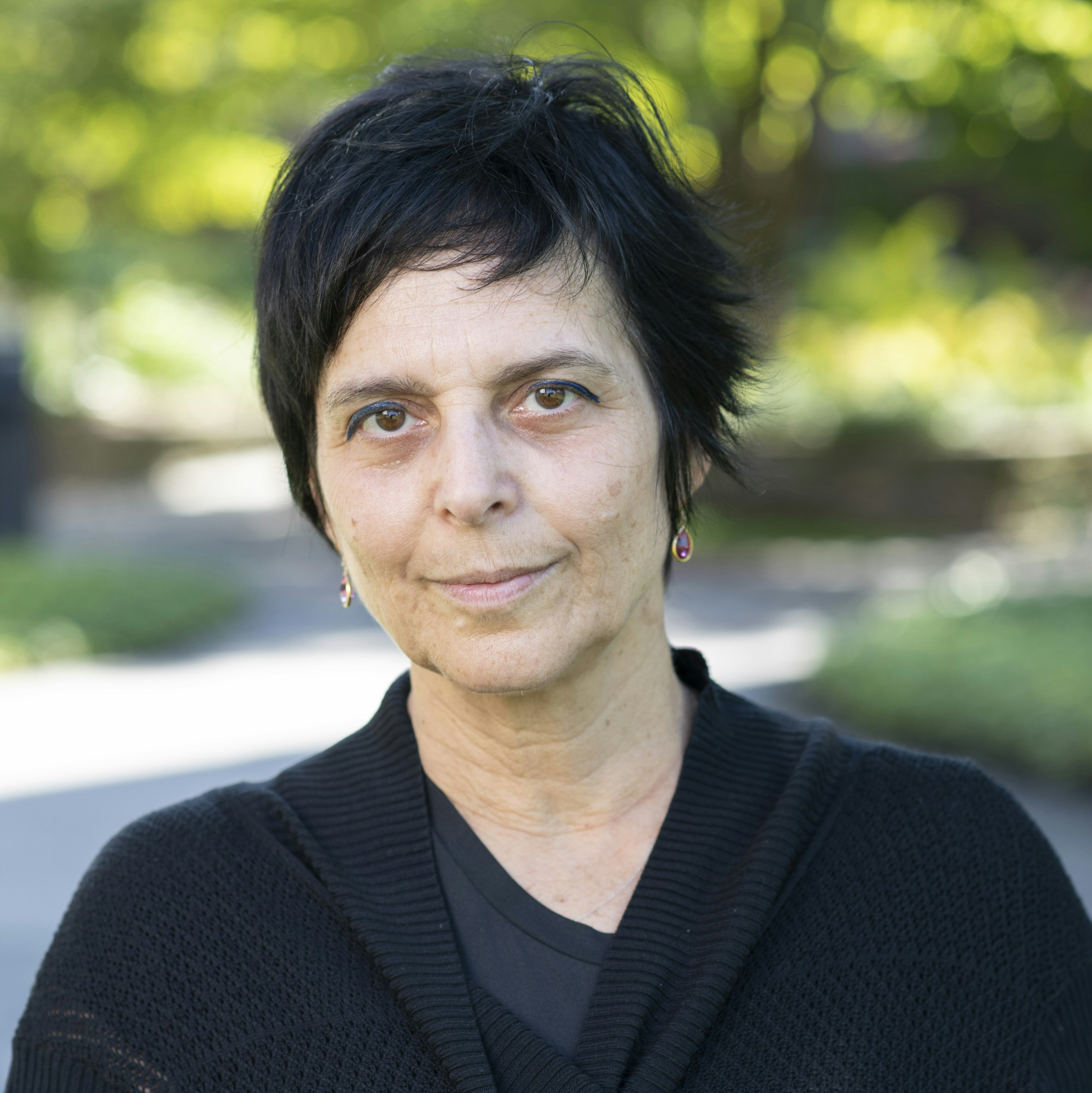
Headshot of Chaya Czernowin
Czernowin photographed by Tony Rinaldo

Born in Israel, Chaya Czernowin left at the age of 25 to study in Germany and the US, and she earned her PhD in Music Composition from UC San Diego (26, 27). She is currently the Walter Bigelow Rosen Professor of Music at Harvard, and has been since 2009 (26). She spent time composing in Japan in 1993-95 and Germany in 1996, and these years helped her to really develop her style and voice as a composer (29).  In 2011, Czernowin won a Guggenheim Fellowship, and in 2016 she won the the 2016 Heidelberger Künstlerinnenpreis (27). These are just a few of her many awards.

Czernowin's work is characterized by "working with metaphor as a means of reaching and analyzing a sound world that is unfamiliar; the use of noise and physical parameters as weight, textural surface; an inquiry of the handling of time; and shifting of scale; and perspective" (26). She has two large theatre works, including Adama, which was commissioned by the Salzburg Festival for Mozart's 250th birthday (28). The opera responds to Mozart's own Zaïde, and it "deals with the impact that a political situation has on the individual and the limited freedom one has when trying to escape this impact" (28). Here is a filmed set of interviews about her opera from the 2006 Salzburg Festival:

Mozart / Czernowin - Zaide - Adama - interviews - (Salzburg Festival 2006)

Explore her website to learn about her interesting pieces and accomplishments. 

Women composers have been overlooked in the classical canon. These living women composers stand on the shoulders of many women that came before them When you hear about a woman composer, living or historical, Give Them A Listen! 


Sources:
  1. Cellist–composer Hildur Guðnadóttir wins Best Score Oscar -- The Strad
  2. Inside Hildur Guðnadóttir's Haunting Score for Todd Phillips' Joker -- Muse by Clio
  3. Hildur Guðnadóttir -- ClassicalFM 
  4. Valerie Coleman -- St Paul Chamber Orchestra
  5. Imani Winds
  6. The Classical Station’s interview with Anthony McGill for Preview! -- The Classical Station
  7. ‘American Stories’ Chronicled: A Contemporary Recording for a Contemporary Time -- The Strad
  8. Gabriela Lena Frank -- St Paul Chamber Orchestra
  9. Borders-leaping composer Gabriela Lena Frank champions change: ‘I’m a woman of color who is partially deaf’ -- San Diego Tribune
  10. Gabriela Lena Frank -- Guggenheim Memorial Foundation
  11. Gabriela Lena Frank -- Philadelphia Chamber Music Society
  12. Gabriela Lena Frank -- Atlanta Symphony Orchestra
  13. MEET THE COMPOSER: Gabriela Lena Frank -- Detroit Symphony Orchestra
  14. Arlene Sierra Composer 
  15. Professor Arlene Sierra -- Cardiff University
  16. ARLENE SIERRA: BIRD SYMPHONY -- Utah Symphony Orchestra
  17. ARLENE SIERRA, COMPOSER -- Meet The Artist Online 
  18. Errollyn Wallen -- Wise Music Classical
  19. errollyn wallen
  20. Errollyn Wallen -- Trinity Laban Teaching Staff
  21. Errollyn Wallen -- Oxford Philharmonic Orchestra
  22. Rae Howell
  23. Rae Howell -- Creative Ballarat
  24. Rae Howell -- Navona Records
  25. Bee-Sharp Honeybee -- Navona Records
  26. Biography -- Chaya Czernowin
  27. Chaya Czernowin -- Harvard Radcliffe Institute
  28. Chaya Czernowin -- Schott Music
  29. Chaya Czernowin -- Harvard Faculty

Sunday, June 11, 2023

New Sounds on an Old Instrument

by Andrea Wallick, cellist 

and Andy Fein, Luthier at Fein Violins


Why does that cello sound like a seagull? How are the sounds I'm hearing coming out of string instruments? It sounds like percussion and overtones. 

If you've ever asked these questions after watching a string performance, the performers were most likely playing their instruments using extended techniques

Watch this George Crumb piece being performed to get an idea of what extended techniques are: 

Ensemble intercontemporain

Monday, June 5, 2023

20 Hours To Montréal & the Philip Glass Ensemble- The 2023 Version of Bach's Walk

Story in Four Parts 

by Andrea Wallick, Cellist at Fein Violins


Part 1: Conceptualization 

I was in the thick of finals, having performances every night, working on my massive paper about Einstein on the Beach, and I randomly had the urge to check out what the Philip Glass Ensemble is doing now. There I saw it... the list of performances with one happening on May 24th in Montréal, Canada. With a quick glance at their performance history over the past three years or so, I realized that if I wanted to ever see them live anytime soon, it would have to be at the May 24th Montréal concert. 

Wednesday, May 24, 2023

The Time to Get Your Instrument Ready For Summer Fun Is Now!

Off to Music Camp?

 Playing Outside: Tips to Summer-ize Your Stringed Instrument

By Diane Houser, Office Manager at Fein Violins, professional violinist & violist 

and Andy Fein, Luthier at Fein Violins

Summer is right around the corner in the Upper Midwest, and if you have plans to play outside over the next few months, now's the time to get your instrument ready for the heat and humidity.

Playing outdoors is fun! Treat your instrument well! 

Stringed instruments are made of wood, a material that expands when it absorbs moisture, and contracts when it dries. To make matters even more complicated, there are two different types of wood used to make violins, violas, and cellos - Spruce for the top and Maple for the back and sides. These two woods expand and contract at different rates, so the best advice is to try to avoid extremes in temperature and humidity

Monday, May 22, 2023

These Are A Few Of Our Favorite Strings- Part IV, Cello

By Andy Fein, Luthier at Fein Violins
with Kevin Berdine And Andrea Wallick

As we have shared in a previous blog post, "These Are A Few Of Our Favorite Strings-Part III, Cello" Larsen strings continue to be a favorite amongst students, teachers, and cellists in our shop. 

Larsen's standard strings continue to be the strongest contender for most cellos and cellists, but our shop cellists have enjoyed each new string produced by Larsen. When Larsen introduced the Magnacore strings, we were all quite excited to try them out. They did not disappoint! We absolutely loved the warmth that Magnacores produced while maintaining the same playability and projection we have come to expect from Larsen. 

Sunday, May 7, 2023

What's THE BEST Instrument Sound?

By Andrea Wallick, cellist and Andy Fein, violin maker at Fein Violins (FineViolins.com)

Have you ever heard an instrument's sound described with physical adjectives such as "dark", "bright", "rough", or "thin"? Sound doesn't produce light, and it's not a physical object, so what do these words actually mean? And more importantly, what kind of words describe a good instrument's sound? 

Rachel Barton Pine discusses the differences between Stradivaris and Guaneri del Gesus

These terms do not come out of nowhere. There are actually subtle differences in the sound composition that make terms like these universal! If two people play different violins with different bows at different volumes, obviously they will sound different. But what if the same person plays two violins with the same bow at the same volume with the same articulation? Will they still sound different? Yes, because of the instrument's timbre.

Tuesday, November 8, 2022

Wolf Tones- Why is my cello howling?


By Kevin Berdine, cellist, and Andy Fein, Luthier at Fein Violins

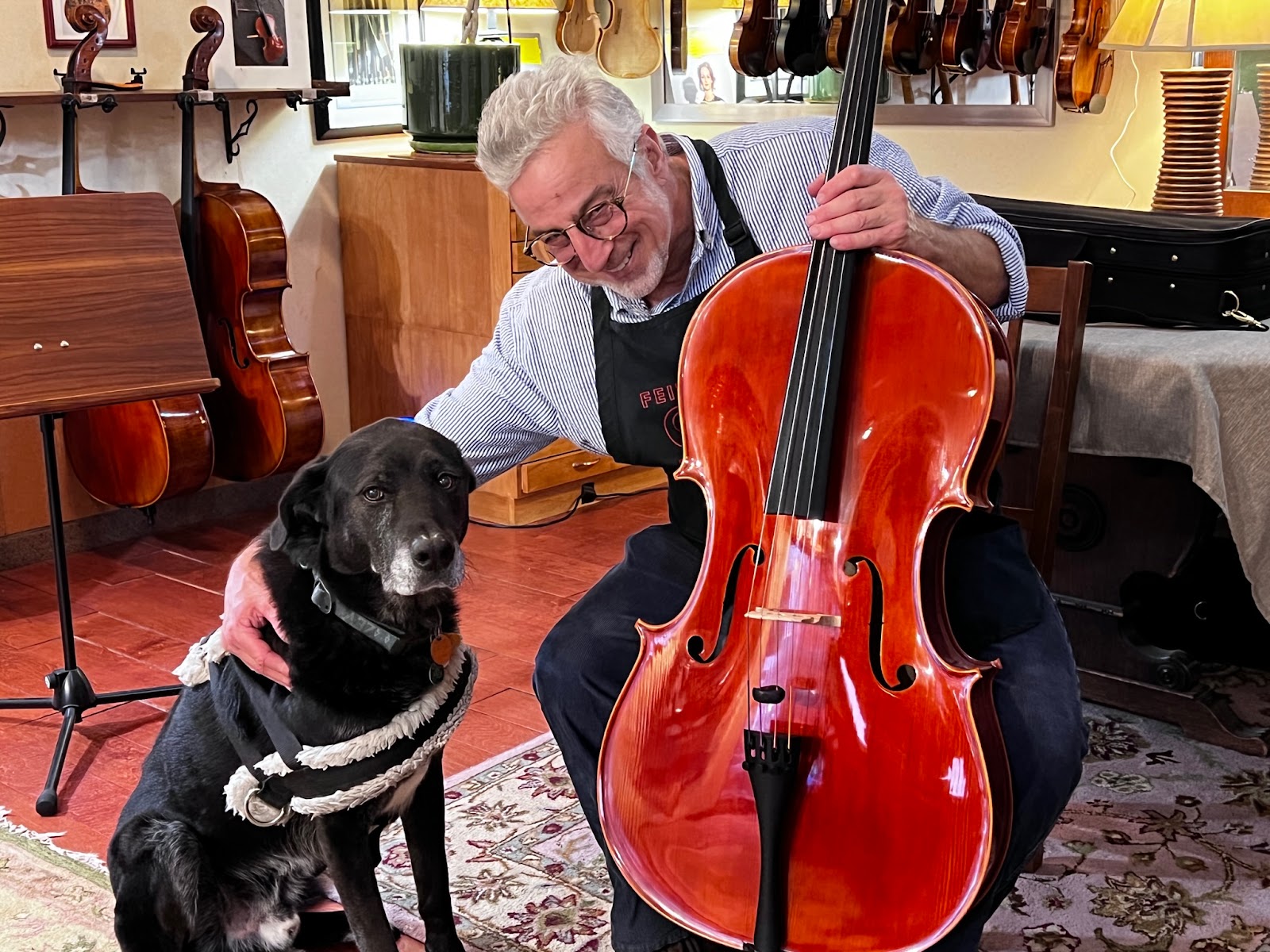
Shop-Dog Zev and Andy discuss wolf tones. Did you know Zev is Hebrew for Wolf? Well, it is.

Have you ever heard your cello howl? For those of you who haven't heard it, this is a weird question, right? But for those who have experienced this phenomenon, you know exactly what we're talking about. A wolf tone is so-named because it sounds a bit like a wolf howling. Wolf note or wolf tone Is there a difference? No! It's two different names for the same phenomenon.

Tuesday, July 12, 2022

The Everchanging Cello

By Andy Fein, Luthier at Fein Violins
and Kevin Berdine

The beloved cello that we know today as a relatively standardized instrument was not always so. Cellos can be traced back to Amati (1581-1632), Gaspar da Salo (1549-1609), and Paolo Maggini (1581-1632). Although still quite recognizable to a modern eye and ear, these proto-cellos were quite different in a number of ways; string material and tuning, neck length and angle, body dimensions, bridge dimensions, arching, bass-bar placement and dimensions, bow design, soundpost dimensions, and even the way in which players held the instrument and bow. For a brief primer, check out Emily Davidson's emilyplayscello Instagram reel.  

The driving forces that propelled design changes, not surprisingly, were playability and sound projection. Simultaneously, while composers were demanding more virtuosity from cellists, performing venues were becoming larger as they shifted from churches to courts to concert halls. This compelled instrument makers to design instruments that allowed for greater agility and a bigger, more-projecting sound.

To achieve a more powerful sound, the high-arched cellos of Amati and early-Stradivari turned into the lower-arched Stradivari "Forma B" inspired instruments that we still play today. In 1710, during Stradivari's golden period,  he introduced the first Forma B, the "Gore-Booth" cello to the world. Dimensions: Length of the Back 75.6cm; Widest Width of the Upper Bout 34.2cm; Widest Width of the Lower Bout 43.8cm; Narrowest Width of the Middle Bout 22.9cm. 

1710 Stradivari "Gore-Booth" Cello 

Today there are roughly 20 "Forma B" cellos in existence. In Stradivari's late-period, he continued on his quest to improve playability by making cellos narrower still. 

As one can imagine, a lower arch necessitated many other adjustments. Externally, while arching was being lowered neck angles were being increased. This combination required taller bridges to be designed to fit the increased string height. To further add pressure to the top and increase sound-projection of the instrument, metal strings were also added to the mix. In addition to adding tension to the strings by making the bridge taller and switching to metal strings, we also see the tuning raised about whole step. These factors led to important changes that most players do not see. Internally, the soundpost dimensions changed as arching decreased. And the bass bar positioning and dimensions changed to add structural support. Additionally, to add more structural stability, Stradivari made these cellos with more substantial wood thicknesses. 
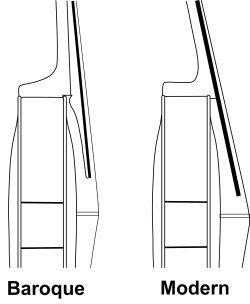

https://www.rickertmusicalinstruments.com/2018/03/comparison-of-the-two-new-violoncello-da-spalla-models-by-d-rickert.html

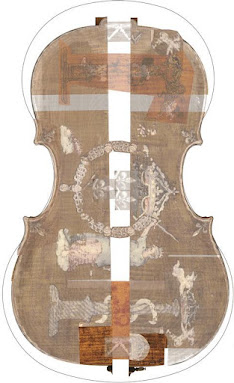
Many great cellos that were made in the Baroque era have since been altered to match modern sensibilities. To achieve a more playable instrument, the overall size was reduced, the neck angle increased, and endpins were added. Additionally, composers began to write music that required more range. Thus neck lengths, too, were increased. Each of the changes allowed a player to navigate around the instrument with greater freedom. Check out this pic, from Matthew Zeller's "Deconstructing the Andrea Amati 'King' Cello," to see how the midsection was removed along the center seam, and the bouts were reduced to cut down the Amati King Cello to modern dimensions. 

For those measuring at home, here is a list of the original dimensions versus cut-down dimensions: Length of the Back 78.2cm cut to 75.5cm; Widest Width of the Upper Bout 39.1cm cut to 34.3xm; Widest Width of the Lower Bout 48.9cm cut to 44.2cm; and Narrowest Width of the Middle Bout 27.7cm cut to 23.6cm. 


While the instrument itself was undergoing dramatic transformations, so too, was the way in which players held the bow. One will see examples of cellists holding the bow underhand (some bassists still play with "German" bows), overhand above frog (modern hold), and overhand higher up the stick.


Although cellos have remained quite standardized since Stradivari's "Forma B," there continue to be many experiments; carbon fiber instruments and bows, endpin material and angle, tuning pegs material and mechanics, string composition, varnish formulas, interior grounds, artificial aging treatments of wood, neck angles, tailpiece materials and shape, and many other interesting tweaks. What will come next? Nobody knows for sure, but it will surely be playability and sound projection that drive future experiments. 

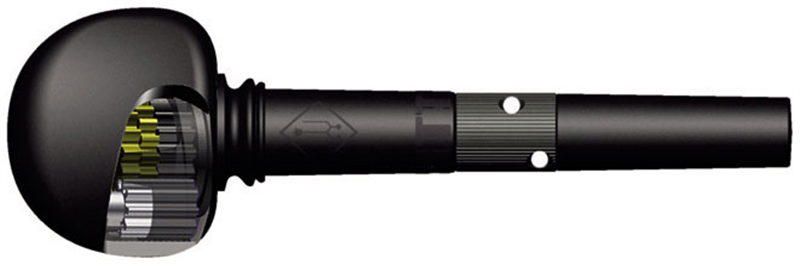
Although playability and sound projection propel most changes, one modern transformation, in honor of comfort and ease, that we have embraced whole-heartedly at Fein Violins, is mechanical pegs. The majority of our instruments leave the shop with these installed. Our clients have absolutely loved the Wittner Finetune Geared Pegs. They make tuning so much easier! I suppose we could say comfort and ease relate to playability-if it hurts to tune, one does not play their instrument! Traditionalists, too, have appreciated the fact that these pegs still look like ebony friction-fitted pegs. You really have to try them out to see just how easy they are to use.  

Are you a cellist or interested in becoming one? Take a look at our Fine Cellos modeled after Stradivari's instruments.


Vanscheeuwijck, Marc (1996) "The Baroque Cello and Its Performance," Performance Practice Review: Vol. 9: No. 1, Article 7. DOI: 10.5642/perfpr.199609.01.07
Available at: https://scholarship.claremont.edu/ppr/vol9/iss1/7


Tuesday, November 16, 2021

Cello Endpins- The Long, The Short, and The None


By Kevin Berdine, cellist, and Andy Fein, Luthier at Fein Violins


Although the endpin is, seemingly, the least interesting part of a cello, have you ever seen a cello without one? Well, the humble endpin was not always a fixture of the cello. In fact, when we look throughout history, we can see that its use evolved quite a bit (and is still evolving)! 

Sunday, July 18, 2021

Supporting Black Creatives and Performers Through ROSIN! Really Cool and Fun Rosin

 I, along with many people, celebrated the idea of making Juneteenth a federal holiday. Juneteenth has traditionally been celebrated on June 19 and marks the day in the year 1865 when Union Army General George Granger read out General Order No.3 in Galveston, Texas. That proclamation announced the end of chattel institutional slavery in Texas, the last state to have "legal" slavery. Of course, it took the point of the guns of the United States Army for slaveholders in Texas to release their slaves. There have been many horrific twists and turns on the march towards freedom for all Americans, but Juneteenth has been a traditionally celebrated Black holiday to commemorate the ending of slavery as a legal institution in all and in each of the United States of America. 


Ted Ellis, Scholar in Residence at Old Dominion University talks about Juneteenth


Monday, June 14, 2021

Cello Stands- Show Off Your Cello!

 By Andy Fein, luthier at Fein Violins and Ivana Truong

Keeping a cello out and more readily playable can encourage more frequent, shorter practice sessions. In fact, with the right set up and care, storing a cello on a stand can be relatively safe and easy! 

Three of our cellos on König & Meyer rubber/cork cello stands

Tuesday, April 27, 2021

The 'Hochstein' Stradivarius Violin of 1715 - An Excellent Model

By Andy Fein (Luthier at Fein Violins) and Mikaela Marget 

In 1978 I (Andy) was a young guy with black hair, a passion for violin making, an intense curiosity about Antonius Stradivarius and Guarnerius del Gesu, and an apprentice violin maker in Chicago. I had even made a trip (read "pilgrimage")  to the Ashmolean Museum in Oxford, England specifically to study the Messiah Stradivarius violin


At that time, the Chicago School of Violin Making was owned by the venerable violin shop of Kenneth Warren and Son. Once a week Kenneth Warren Sr. would bring wonderful instruments to the school for the apprentices to study. One cold Chicago day, Mr Warren came in, carefully opened a beautiful case, and pulled out an exquisite violin. He held the violin up and asked, "Any guesses?" I impulsively said "Looks like a Golden Period Strad. Looks like the Messiah, but it's not. Ummm, 1715? 1716?" It was the 'Hochstein' Stradivarius violin, made circa 1715. Thus I acquired the amused dislike of every other student at the school. 

Original Hochstein Stradivarius, photo from Andy's collection
Our 'Hochstein' Stradivarius model Violin 

Sunday, February 28, 2021

Cellist Singer/Songwriters- Sometimes, a Cello is Just Plucked

By Andy Fein, Luthier at Fein Violins and Mikaela Marget 

In orchestra settings, cello sections move fluidly between holding down baselines, playing a rich harmony texture, or jumping to the forefront to play an entrancing melody. In folk music, the cello is used as a chordal, melodic, or even rhythmic instrument (ever heard of "the chop"?). 


Ok, so the cello can play many roles in a variety of traditional contexts, but how does it function as a songwriting partner? Turns out there are Singer-songwriters who utilize the cello as a chordal accompaniment instrument. These musicians may convince you that it is time to ditch the guitar for something deeper... 

Thursday, November 19, 2020

Why Do Strings Break?

By Andy Fein, Luthier at Fein Violins

and Ivana Truong


Most string players have had the awful experience of getting all set for a lesson, concert, or recital and BAM a string breaks. It seems like the bigger the occasion, the more likelihood of a string breaking.


Why do strings break? What can you do to prevent a string breaking at the WORST POSSIBLE MOMENT?

Violinist Midori Goto, age 14, breaks two strings during her debut performance, 
and didn't even flinch! 

Thursday, October 29, 2020

Environmentalism and Violin-making

By Andy Fein Luthier, at Fein Violins & Mikaela Marget

Environmental Sustainability in Violin Making 

Spruce, Maple, Basswood, Ebony, Pernambuco, Tetul, Rosewood, and Boxwood. What are these? All of these are types of wood that are used in your stringed instrument or bow. They are wood from trees that grew for decades or centuries before they were cut down to make your viola, viola, cello, or bow. After being cut down and milled, they are carefully stored to air dry for decades more. 
    
Like trees? Like the environmental benefits of trees? You know stuff like oxygen to breathe, carbon storing to slow climate change, soil to stabilize and nurture, shade to sit under, fruit and nuts to eat, birds and animals that live in the forest, and sap to make into syrup. If you do, be a good steward and know that your instrument comes from the health of forests.

Mata Atlantica, Brazil
A. Fein & Atelier Cremone Seraph Cello


Sunday, September 13, 2020

Bow Bugs- Little Bugs That LOVE Bow Hair

By Andy Fein, Luthier at Fein Violins,

and Ivana Truong

 If you open up your case and you see this- You Have BOW BUGS


"What??? Bugs are eating my bow?"

No! Just the bow hair. (Fans of Schitts Creek are now hearing Alexis say "EW!")

Monday, July 27, 2020

Tips & Tricks for Surviving the Online Lesson World

By Andy Fein, Luthier at Fein Violins and Mikaela Marget

"A little too sharp... not quite... now it's too flat! Go the other way... Nope, too far..." Bam! Oops. Now you need a new string.  


If you're a student who has recently had to start taking online-lessons, you know this struggle: learning to tune. There can be a bit of a learning curve to this, but don't get discouraged--we are here to help! 

We've made some helpful videos to help you as students (or parents) learn how to tune, change a string, and reset a bridge without teacher help during the times of video lessons. This way, even though you can't see your teacher in-person, you can keep up with the daily maintenance of your instrument.


Monday, June 22, 2020

Who Invented the Violin? Sephardic Jews and the Early Days of the Violin

By Andy Fein, Luthier at Fein Violins, and Mikaela Marget

Who made the first violin? 

With a cursory internet search, you may be convinced that the mastermind behind all modern violin making was Andrea Amati of Cremona; many give him credit for the oldest existent violin, a 1546 instrument that is now lost. The truth, though, is more complicated than that; first of all, we don’t even know if he was responsible for the very first modern violin. Even if he was, Amati didn’t just come up with a great idea out of nowhere! 

ex-Kurtz violin by Andrea Amati

Tuesday, June 2, 2020

Stage Fright/ Performance Anxiety- Got Yours?

Great Violinist Yehudi Menuhin was a Proponent of Yoga

By Andy Fein, Luthier at Fein Violins,
and Ivana Truong

"Relax. RELAX. JUST RELAX, YOU'LL PLAY SOOOO MUCH BETTER?" Ever had such sage advice thrown your way? Yes, most musicians have. And it doesn't help. But learning to relax and focus on your performance truly will help you play better. But how do you do it when every part of your being is telling you just the opposite?

Though perhaps to different extents, every musician understands the stomach-turning restlessness that precedes a performance, not to mention the heart-racing blur of the performance itself. For some musicians, the feeling becomes manageable with time, as confidence in their technique grows and the player gains more experience with public performances. For others, performance anxiety can become a serious issue preventing them from pursuing music more seriously.