Saturday, June 16, 2012

Making it in the music world - The Sonus Quartet

Written by: Amy Tobin of Fein Violins


I recently purchased a copy of Norah Jones' new album, "Little Broken Hearts." While I was looking at the cover (yes, I still buy actual, physical copies of CDs....I like to know who is playing what on each track), I noticed that there was a list of musicians who are billed as 'co-stars' of sorts. One name caught my eye.......the Sonus Quartet.

The Sonus Quartet


The Sonus Quartet is comprised of Caroline Campbell (violin I), Kathleen Sloane (violin II), Neel Hammond (viola), and Vanessa Freebairn-Smith (cello). Each one of these musicians is phenomenal in their own right -

Tuesday, June 12, 2012

Reflections On Race, Inequality And Classical Music

By Stefan Aune and Andy Fein of Fein Violins
George Bridgetower

Classical music has had an image of being mainly white people's music. Unfortunately, this has been fostered by Euro-centric orchestras and organizations for hundreds of years. But that image is not entirely true and never has been. This blog post will feature some of the finest historical musicians of color, a few contemporary musicians of color, and a commentary on the current of racism that has damaged classical music for far too long.


"Juba" by Florence Price, featuring-
Gabriela Diaz, violin Mina Lavcheva, violin Ashleigh Gordon, viola Seth Parker Woods, cello


"Vienna Philharmonic is an orchestra of white men playing music by white men for white people"
- Werner Resel, former Vienna Philarmonic Chairman

Sunday, June 10, 2012

The Vienna Philharmonic-- Artistry and Discrimination

By Matt Lammers of Fein Violins

The Vienna Philharmonic, or Wiener Philharmoniker, has been an ambassador of musical greatness since its first concert of March 28, 1842. In recent years, however, the orchestra has been no stranger to controversy on an international scale. Their former policy that outrightly prohibited women from membership brought ongoing attention to the ensemble's race and gender demographics.While the media delights in its idiosyncrasies, the Vienna Philharmonic is an interesting case study in orchestral politics and ethics.


The Vienna Philharmonic playing Radetzky March, their signature piece, at the annual New Years Concert this past January

Monday, June 4, 2012

French Influence On Italian Violin-Making

By Matt Lammers and Andy Fein, Luthier at Fein Violins

Many years ago I (Andy) was visiting the old Jacques Francais violin shop in New York and examining an Annibale Fagnola violin with the famous restorer and violin expert Rene' Morel. He held the violin up, looked directly at the scroll and exclaimed, "Isn't it remarkable how much the Italian makers learned from the French?"
A violin by Annibale Fagnola, Turin, circa 1925

Wednesday, May 30, 2012

What are Violins, Violas, & Cellos Made Of?

By Matt Lammers and Andy Fein

A friend of ours on Facebook recently sent us a message and asked, "what wood works best for different parts of the cello, and why?" So we sat down at the computer, as is our routine for questions of this sort, to pull up a link to our blog entry about instrument materials. Wouldn't you know it, we didn't have one!

This is a question that often confuses instrument buyers and string players alike. The falsely satisfactory conclusion, "they're made of wood, except for the strings; I think they're steel," is too often drawn in response to an issue that is far more in depth than that.

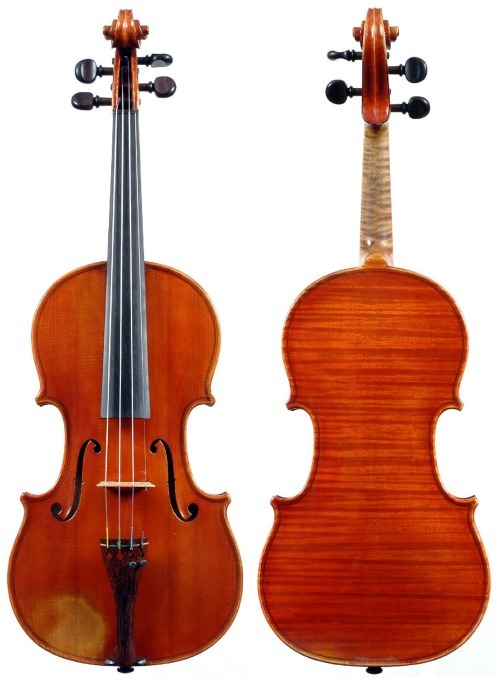
In one sense, though, the answer is quite simple and almost always consistent for modern violins, violas, and cellos- Maple is used for the back, sides and neck; Spruce is used for the top and the fingerboard is made from Ebony. But Spruce and Maple are broad categories of trees that encompass several species. The species of wood is the primary variable concerning sound, visual aesthetic, and durability, however the wood's age, grain structure, and cut style, also play pivotal roles in these attributes.

Good wood choice makes a fine violin pleasing to the eye, but even more so to the ear