Showing posts with label W.E. Hill Sons. Show all posts

Monday, February 6, 2012

Bernard Greenhouse and the auctioning of the Countess of Stainlein / Paganini Stradivarius Cello

By Stefan Aune

The famous "Countess of Stainlein, ex-Paganini of 1707" Stradivarius cello that was owned by the late Bernard Greenhouse has been sold at auction for more than $6 million to an anonymous patron of the arts in Montreal. This auction most likely sets a new record for the sale of a cello, the previous record being about $5 million. The cello, which was made by Stradivarius during his prolific "golden period," has been played on by Bernard Greenhouse since the 1950's. Greenhouse passed away in May of 2011, and his family arranged to sell his cello via sealed auction through Reuning & Sons Violins in Boston. The "anonymous patron" plans to loan the cello to 18 year old Stéphane Tétreault, a student studying cello and conducting at the University of Montreal.

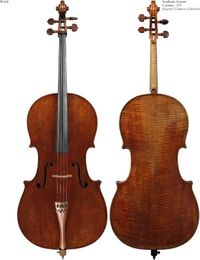
The Countess of Stainlein, ex-Paganini Stradivarius (allthingsstrings.com)


The Countess of Stainlein, Paganini Stradivarius cello, Cremona, 1707

Sunday, January 22, 2012

Mirecourt, France. Headwaters of French Violin Making

Written by Andy Fein, Violin Maker and Owner, Fein Violins, Ltd.

Many of France's best violin and bow makers from the 1700s to the present day share a very similar biography - Jacques (or Jean-Baptiste, Jeanne, Rene', Renee', Andre', Emile, etc.) were born in Mirecourt where they learned the trade from their father (or uncle, grandfather, brother,mother, sister, etc.). Starting at about age twelve, they worked at the bench with their family making instruments and bows... A shop owner in Paris (Vuillaume, Chanot, Caressa, Francais, etc.) heard of their talent and invited them to come to Paris. In Paris they received great acclaim for their work... Or didn't, so they slunk back to Mirecourt and toiled away in one of the production workshops there.

An H. Derazey violin, Mirecourt circa 1860

Wednesday, November 9, 2011

Chanot-Chardon: The Violin-Making Soap Opera Family

Written by Stefan Aune of Fein Violins

The Chanot-Chardon family of French and English violin makers trace their origins to Joseph Chanot, the first member of the family to add violin-maker as a profession. Joseph ran a small shop in Mirecourt, France, and the first violins that feature his label were produced in 1790. Joseph was a violin-maker, tradesman, and a farmer; a triple threat of vocations made necessary by his twelve children (that's quite a few mouths to feed). Two of Joseph's sons would follow in their father's footsteps and establish the Chanot name among the elite of French violin makers. The eldest, Francois, studied mathematics in Paris, graduating from the Ecole Polytechnique. He went on to specialize in the construction of naval war-ships, before taking an interest in violin making, albeit from a very scientific point of view. His thesis, titled (translated from French) "To Fix the Method a Violin Maker Must Use in the Workmanship of Stringed and Bowed Instruments" was accepted by a committee of experts and professional Alexandre Boucher played on the instrument built to Francois' specifications. Francois would go on to present a second thesis on instrument construction, and had the opportunity to present his research to the King of France during an exhibition. His forms were eventually taken up by the violin firm "Lete's Widow & Payonne," where they were used by the a young Jean Baptiste Vuillaume, who would go on to become an internationally renowned violin maker and a close friend of the Chanot family.

The Chanot shop in Paris
Picture from Parisian Violin Makers in the XIXth and XXth Centuries, Tome 1: The Family Chanot-Chardon by Sylvette Milliot
The youngest son, Georges, apprenticed with his father before joining Francois in the capital. He worked for a succession of Parisian makers before opening his own shop, founded in 1821. Georges was joined by his pupil Florentine Demolliens,  a 24 year old woman whose position as a violin maker caused a bit of a sensation, as women traditionally did not make violins at that point in history. Georges and Florentine eventually married, after having several children out of wed-lock, and the children were all legitimized together through baptism after the marriage. Wishing to get his name out there, Georges spent seven years traveling to Spain, Portugal, Germany, and England, and Russia, where he cultivated relationships with other makers and gained many international clients. His most notable customer was Tarisio, to whom he sold several highly skilled copies of Stradivarius and Guarnerius violins. In 1840, his wife and business partner Flornetine became ill, retiring to the countryside where she was cared for by her maid, Rose Chardon. Roses' sister, Antoineette Chardon, traveled to Paris to help Georges with the business. Their working relationship blossomed into some thing more, and Georges and Antoinette would eventually have a son together, Marie-Joseph Chardon. In the baptism act, Georges was named the godfather, and it wasn't until adulthood that Joseph learned that Georges was in fact his father. He would carry the family name Chardon, and pass it on to his children.

Monday, August 15, 2011

Hill & Sons Violins. One-offs to Workshop

Written by Andy Fein, luthier at Fein Violins
and Stefan Aune


The Hill family of violin makers reaches deep into the history of violins. You can read our blog on the rise of the Hill firm to get a nice overview.

In the mid 1700's Joseph Hill was working at the Haymarket, in London, "at the sign of the Harp and Flute". He had a small shop at first and was probably working alone. Most of his instruments were made on a high arch model along the lines of Amati and Stainer. Joseph Hill's sons, William, Joseph, Benjamin, and Lockey all became violin makers as well. They continued with the high arched models that were popular at that time.

Lockey Hill's son, Henry Lockey, adopted the Stradivarius model and abandoned the higher arched models. For an individual maker, Henry Lockey is probably the finest maker of the Hill family and his instruments are some of the most valuable English instruments.

Sunday, August 14, 2011

Bows from W.E. Hill & Sons

Written by: Andy Fein, luthier at Fein Violin
 and Angie Newgren

The Hill Violin shop was one of the greatest and largest violin shops in the world from the mid 1800s until the firm's demise in 1992.

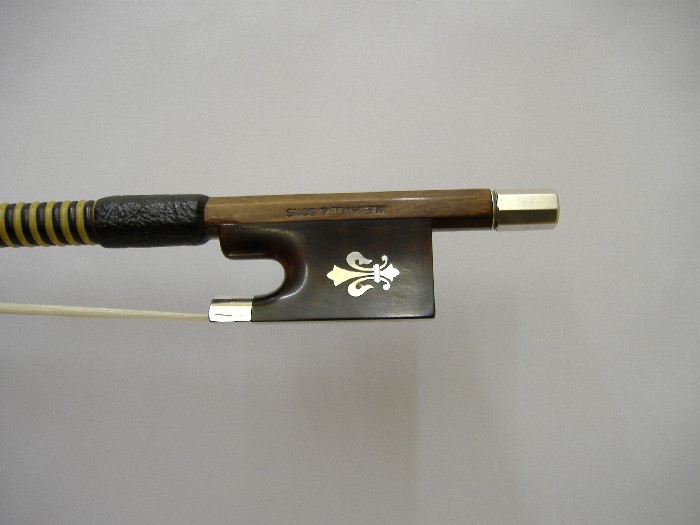
W. E Hill violin bow with a fleur-de-lys design in the frog

Hopefully you have read our blog on the history of the firm. Some of the best products of W.E. Hill & Sons were their bows. Beautiful violin, viola and cello bows! Bows made of the finest Pernambuco available.  With fittings (frogs, butons, slides, and tips)  made of silver, gold, ebony, tortoiseshell, mother of pearl, abalone and ivory. Sometimes with elaborate designs. Sometimes very utilitarian looking. But almost always producing a great playing stick! 

Were the bows made by W.E. Hill or any other member of the Hill family? No. Not at all. Alfred Hill became quite the connoisseur of French bows. Alfred imposed on a long succession of bow makers the "Hill" bow style based on a Tourte bow for violins and a Voirin bow for cellos. It was Alfred's expertise and taste, combined with the skill of the bow makers, that produced incredibly consistent, high quality and very recognizable bows.

Friday, August 12, 2011

W.E. Hill & Sons - The Rise of England's Greatest Violin Firm

Written By Stefan Aune of Fein Violins

The Hill family of London is synonymous with high quality instruments, even higher quality bows, and for operating one of the most famous violin shops in the world. Particularly noted for being experts on the identification and restoration of older instruments, the Universal Dictionary of Violin & Bow Makers by William Henley calls the Hill guarantee "the most reliable in the entire world." The Hill family's roots go back hundreds of years in the history of English violin making, and they are one of the true institutions of the trade.

Most violin historians trace the family back to Joseph Hill, born in 1715. A well known and respected London maker, Joseph Hill had four violin-making sons, of whom Lockey Hill is considered the most distinguished. His son, Henry Lockey Hill, was the first Hill to adopt the Stradivarius model for his instruments, and to this day his instruments, particularly the cellos, remain some of the most valuable English instruments produced. His adaptation of the Stradivarius model raised the Hill family standard above that of general trade work and further engraved the Hill name into the annals of violin-making history. Henry Lockey Hill had five sons, and his fourth, William Ebsworth Hill, carried the family name even further when he founded the violin firm W.E. Hill & Sons in 1887 in London.

The bridge on the 'Lady Blunt' Stradivarius- W.E. Hill & Sons
(C) Tarisio 2011

Monday, June 13, 2011

Rosin - clearing the dust!

Written by: Amy Tobin of Fein Violins

Rosin is an absolute necessity to a string player. Without it, we wouldn't make any sound at all, so learning how to use it, and which kind to use, is essential!

When it comes to rosin, for any string instrument, there are two basic kinds: light and dark. Light rosin is usually lighter in color (this is not always the case, especially with cello rosin), and it is a bit harder than dark rosin. Light rosin can be a better choice in the summer, or in warmer climates, because it takes a little more heat and humidity to soften it. Dark rosin is a great choice in the winter because the softer rosin will provide a little more grip on those cold, dry days.

As I mentioned before, the world of rosin can be extremely overwhelming! There are so many different kinds, so many different prices, how do you know which kind to use?!