Showing posts with label bows. Show all posts

Tuesday, February 23, 2016

Wood or Carbon Bows- Which are Better?

By Andy Fein, luthier at Fein Violins
 & Martha McDermott

Recently, a Facebook friend asked a reasonably simple question, "Which are better, wood or carbon bows?" And the definitive, absolutely right answer is......


Sunday, January 22, 2012

Mirecourt, France. Where the Seeds of French Bow Making Were Sown.

By Andy Fein and Angie Newgren

In the twenty-first century, violin makers (luthiers) and bow makers (archetiers) are usually two separate people with skill sets that are very rarely combined. It would seem that a luthier would be interested in making the bows that go with their instruments, but bow making is entirely its own occupation.

Violin bow attributed to Francois Jude Gaulard, Mirecourt, ca. 1845-1850

Thursday, December 1, 2011

The History of the Violin:
Early Stringed Instruments and the Development of the Bow

By Stefan Aune of Fein Violins

Tracing the origins of the violin is difficult - evidence of the earliest stringed instruments is primarily found in sculptures and works of art, as instruments made of wood are unlikely to survive for thousands of years. Cultures such as the ancient Greeks and Egyptians made use of stringed instruments, but they did not make use of bows, and the development of the bow is what sets the violin family and its ancestors apart from harps, guitars and other early stringed instruments. A common theory, which is discussed and refuted by Ed. Heron-Allen in his book Violin-Making, as it was, and is, attributes the earliest violins to the Israelites, citing passages in the Bible such as Psalm 81:2 that says "The pleasant harpe, with the viol," or a passage from the book of Samuel that says "And David and all the house of Israel played before the Lord with all manner of instrumentys of fyrre woode, wyth harpes, psalteries, timberelles, fyddelles, and symbals." These passages that seem to reference the viol or fiddle are in fact mistranslations of the Hebrew word for harp, and no word that would signify "bowed instrument" appears in the earliest versions of the Bible.

An ancient Greek vase, which depicts a phorminx, and early Grecian stringed instrument

Tuesday, November 22, 2011

Eugene Sartory:
Violin Bows of Sartorial Splendor

Mirecourt, France has been the birthplace and springboard of most of France's great violin makers and bow makers. The typical route to glory starts with birth and childhood in Mirecourt (often with a father or elder brother already working in the field), an apprenticeship that begins at a young age, and then a quantum leap to Paris, where the artiste either grabs the gold ring or slinks back to Mirecourt, to hang his head in shame.

Eugene Nicolas Sartory was no exception to this plan. Born in Mirecourt in 1871, he apprenticed with his father, a bow maker, for a short while, before heading off to Paris. He grabbed that gold ring and held on tight!

E.SARTORY A PARIS violin bow

Saturday, October 29, 2011

The Greatest Bow Maker You've Never Heard Of- Nicolaus Kittel

By Andy Fein, luthier at Fein Violins

Tourte,Vorin, Vuillaume, Hill, Nurnberger, Sartory, Kittel. Wait, Kittel? What's that name doing in the ranks of great bow makers?

Here's another list: Heifetz, Seidel, Vieuxtemps, Elman, Stern, Kochanski, Rosand, Erica Morini, Zimbalist, Kogan, Menuhin, and Vadim Repin. What do they have in common? (OK, besides that most of them are MOTs!) They are all violin soloists that used and loved Kittel bows. And preferred them over any of the French bow makers, including Tourte.

Yehudi Menuhin preferred Kittel bows

Sunday, September 25, 2011

Five Things You'll Need to Start the Season Off Right & Sound Your Best

By staff at Fein Violins

It's the end of September and the weather and temperature have settled into the next season: Fall. Auditions everywhere are being held, and orchestras and ensembles are beginning to start again as well. There are a few things you can do as a player to create better sound, and keep your instrument in its best mode. Now is the perfect time to do it!
  1. Straighten Your Bridge.
    Check to see if your bridge is still on correctly.
    I was preparing for an audition the other day, and while practicing I noticed that sometimes my strings gave out a false sound. With an upcoming audition, I wanted all the sound I played to be fluent and pure. But my bridge was leaning forward, out of position and preventing me from creating that sound. The vibration of the bridge is what translates the vibrations of the strings to the instrument. After I straightened my bridge, my violin played much more like its old self. I didn't have any more distractions for my audition, which helped me focus on playing. If you're not comfortable adjusting your bridge, bring it to your violin shop, where your luthier should be more than happy to help. You'll need your luthier for the next few steps as well.


Friday, August 19, 2011

François Tourte and the Making of the Modern Bow

Written by Andy Fein, luthier at Fein Violins
 and Angie Newgren

The 18th century was a period of great productivity in the arts and commerce. Many changes were going on: World trade, the French Revolution, the  end of the Baroque period and the beginning of the Classical period (circa 1750). For string players, luthiers and bow makers, the advance in playing techniques demanded better and different equipment. Bows underwent a profound change, from the Baroque bow, which was the standard, to the "modern" bow, which we now use.

Up until the middle of the 18th century, bows were more of an accessory for a violin instead of an integral part of the instrument's sound. Bow makers were continuously experimenting with different techniques and materials, but they never went too far out of the "guidelines" that were documented for bow making.

The baroque style bow was usually made of snake-wood (a stiffer and denser wood) rather than the modern bow which uses pernambuco (Pernambuco Blog).  Baroque bows were shaped into a convex curve, which is the opposite of how today's bows are shaped. The bow was arched more extremely, looking more like the bow from a bow-and-arrow. The hair on the bow was bundled, and only half the amount we use today was put on a baroque bow. Lastly, the length of the hair was only about three-quarters of the length of our modern bows.


Wednesday, August 17, 2011

Colonizaton & Commerce: Pernambuco Wood and the Development of the Modern Bow

Written by Stefan Aune of Fein Violins

In 1492 Columbus made his first voyage to what he called the "New World" - a voyage that sparked the European colonization and settlement of what we now know as North and South America. This voyage triggered a rush of settlement and conquest that lasted for hundreds of years, with the great European powers carving up both continents into colonies dedicated to the extraction of resources, the conversion of indigenous peoples to Christianity, and the creation of settlements. The profound exploitation of natural resources coupled with the catastrophic loss of life for indigenous peoples made the colonization of the Americas a grim chapter in human history. The politics, economics, and entire social fabric of much of our modern world comes out of this colonial period, and you might be surprised to find that stringed instruments and bows are no exception. The modern bow, as developed by Francois Xavier Tourte and other bow craftsmen in Europe during the 18th century, made use of a wood known as "pau-brasil," "brazil wood," or "pernambuco." This wood would revolutionize the bow-making world, but at great cost to both natural resources and human lives.

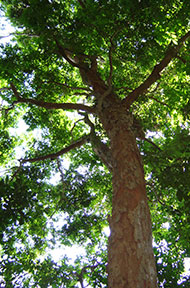
A "Brazil Wood" or "Pernambuco" Tree

Sunday, August 14, 2011

Bows from W.E. Hill & Sons

Written by: Andy Fein, luthier at Fein Violin
 and Angie Newgren

The Hill Violin shop was one of the greatest and largest violin shops in the world from the mid 1800s until the firm's demise in 1992.

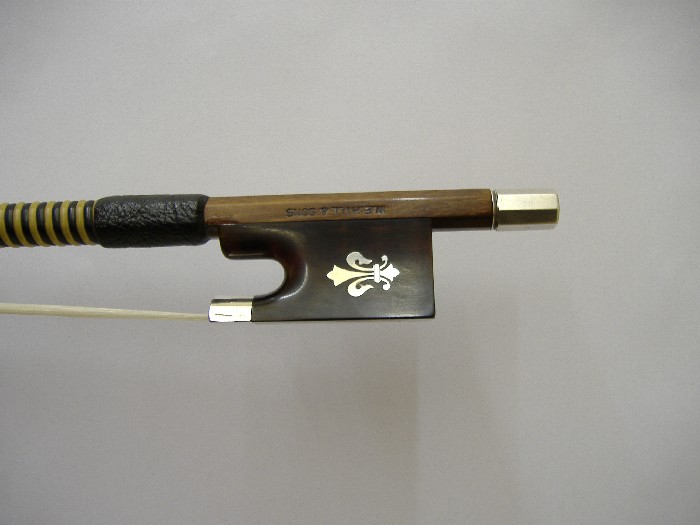
W. E Hill violin bow with a fleur-de-lys design in the frog

Hopefully you have read our blog on the history of the firm. Some of the best products of W.E. Hill & Sons were their bows. Beautiful violin, viola and cello bows! Bows made of the finest Pernambuco available.  With fittings (frogs, butons, slides, and tips)  made of silver, gold, ebony, tortoiseshell, mother of pearl, abalone and ivory. Sometimes with elaborate designs. Sometimes very utilitarian looking. But almost always producing a great playing stick! 

Were the bows made by W.E. Hill or any other member of the Hill family? No. Not at all. Alfred Hill became quite the connoisseur of French bows. Alfred imposed on a long succession of bow makers the "Hill" bow style based on a Tourte bow for violins and a Voirin bow for cellos. It was Alfred's expertise and taste, combined with the skill of the bow makers, that produced incredibly consistent, high quality and very recognizable bows.

Friday, August 12, 2011

W.E. Hill & Sons - The Rise of England's Greatest Violin Firm

Written By Stefan Aune of Fein Violins

The Hill family of London is synonymous with high quality instruments, even higher quality bows, and for operating one of the most famous violin shops in the world. Particularly noted for being experts on the identification and restoration of older instruments, the Universal Dictionary of Violin & Bow Makers by William Henley calls the Hill guarantee "the most reliable in the entire world." The Hill family's roots go back hundreds of years in the history of English violin making, and they are one of the true institutions of the trade.

Most violin historians trace the family back to Joseph Hill, born in 1715. A well known and respected London maker, Joseph Hill had four violin-making sons, of whom Lockey Hill is considered the most distinguished. His son, Henry Lockey Hill, was the first Hill to adopt the Stradivarius model for his instruments, and to this day his instruments, particularly the cellos, remain some of the most valuable English instruments produced. His adaptation of the Stradivarius model raised the Hill family standard above that of general trade work and further engraved the Hill name into the annals of violin-making history. Henry Lockey Hill had five sons, and his fourth, William Ebsworth Hill, carried the family name even further when he founded the violin firm W.E. Hill & Sons in 1887 in London.

The bridge on the 'Lady Blunt' Stradivarius- W.E. Hill & Sons
(C) Tarisio 2011

Sunday, July 31, 2011

Jean-Baptiste Vuillaume. Luthier, Bow Maker & Dealer Extraordinaire

By Fein Violin Staff

Jean-Baptiste Vuillaume is an extremely important figure in the world of violins. Vuillaume had a shop in Paris from 1822 until his death in 1875. He was admired by and friends with Paganini, Ole Bull, and a host of other great soloists.

Label of an 1841 Jean-Baptiste Vuillaume cello

He was three steps removed from Stradivarius' workshop. After Antonius Stradivarius died, his entire workshop and remaining instruments were purchased by Count Cozio. Luigi Tarisio, an itinerant violin dealer purchased many instruments from Count Cozio and brought them to Paris. Vuillaume purchased many Stradivarius instruments from Tarisio. When Tarisio died, Vuillaume traveled directly to Italy to purchase his remaining collection of Stradivarius instruments. And other Cremonese instruments as well. Guaneris, Amatis, Bergonzis, Ruggieris, Rogeris and many more. Just about every Stradivarius and Guarnerius del Gesu passed through Vuillaume's shop at some point.

Friday, July 15, 2011

10 Things You Can Do Today to Make Your Violin, Viola, or Cello Sound Better

Written by Andy Fein, luthier at Fein Violins

Every string player wants to sound better. Here are 10 things you can do today (not tomorrow, not next week) to make you and your instrument sound better.

1) Practice. Hah! Bet you didn't think that was one of the 10 things. But it is. Practice the hard parts, practice with quiet concentration, put the time in and you'll get multiple dividends out.

Saturday, June 25, 2011

What's Wrong With My Bow?

 Written by: Amy Tobin of Fein Violins

In the process of writing posts about violin bows, (how to take care of them, round vs. octagonal bows,  how much bow tension is correct, and whether a better bow really makes a difference) I thought it would be appropriate to write one more post that is sort of a diagnostic of violin bows. This will also apply to cello and viola bows, but, from hereon, I will write "violin."

There are a few things that can happen with violin bows that can worry players.

Monday, June 13, 2011

Rosin - clearing the dust!

Written by: Amy Tobin of Fein Violins

Rosin is an absolute necessity to a string player. Without it, we wouldn't make any sound at all, so learning how to use it, and which kind to use, is essential!

When it comes to rosin, for any string instrument, there are two basic kinds: light and dark. Light rosin is usually lighter in color (this is not always the case, especially with cello rosin), and it is a bit harder than dark rosin. Light rosin can be a better choice in the summer, or in warmer climates, because it takes a little more heat and humidity to soften it. Dark rosin is a great choice in the winter because the softer rosin will provide a little more grip on those cold, dry days.

As I mentioned before, the world of rosin can be extremely overwhelming! There are so many different kinds, so many different prices, how do you know which kind to use?!

Friday, June 10, 2011

Bows - How Much Difference Can There Be?

Written by: Amy Tobin of Fein Violins

When I have musicians come in to look at instruments, after finding their perfect match, I then say "now let's look at bows." In many cases the next question is then "how much of a difference can that make?" The short answer to this is a lot!

When it comes to bows,

Wednesday, June 8, 2011

Violin Bow Hair: Having a Good Hair Day

Written by: Angie Newgren of Fein Violins


Since I first started working at Fein Violins, my knowledge of stringed instruments and bows has grown quite a bit. One thing I was particularly interested in was bow hair, and what goes on before it is in the shop. I knew that most comes from horse hair, but I didn't know specifics, so I did some research.


There are only a few types of bow hair that makers select to use on their bows.

Saturday, June 4, 2011

Violin Bows- Too Tight, Too Loose, Just Right

 Written by Amy Tobin of Fein Violins

When you are learning how to play a bowed string instrument (violin, viola, cello), there are a lot of things about the process that can seem a bit nebulous and mystifying. It can be overwhelming for a beginning student because so much of what we do is seemingly done by feel.

One of those things that seem to be especially difficult to grasp early on is how much to tighten the bow when you play. Today I am going to give you a couple of quick tips to help you with this!

First of all,

Friday, May 27, 2011

Round or Octagonal Bows?

Written by Amy Tobin of Fein Violins

Design question- Octagonal bow stick or Round bow stick - We get asked this question a lot!
The answer is really whichever bow sounds best with your violin (or viola, or cello), and whichever bow feels best to you (hopefully they are one and the same!).

This photo is an example
of a round stick:


Violin bow with round stick


And here is an example

Saturday, April 30, 2011

Bow Care 101

Written by Debra Krein, violinist at Fein Violins:

Your bow is HALF of your sound, so it needs just as much TLC as your instrument!

Bows are very fragile (except for good ol' carbon graphite bows), so you need to treat them like you would treat an infant. Hopefully, you aren't the type of person who would lean on an infant while standing, or use an infant to tap on your music stand - I think we've all seen people doing both of these things (and worse!) to their bows. These are, of course, the same people who seem so astonished when their bow breaks. I guess some people need to break their bow, before realizing that they are not made out of titanium.

However, you do not have to be one of these people! The following tips on how to take care of your bow will help prevent costly bow repairs.

Tuesday, April 12, 2011

Bows

Written by Andy Fein, owner and luthier, Fein Violins:

Pernambuco. Per- nam- boo- koh.
Pernambuco wood has been the standard wood for violin, viola and cello bows since about 1780 when Francois Xavier Tourte began to use Pernambuco and developed the modern violin bow. Pernambuco is the best possible material for bows. It possesses the right qualities that can be transformed into a good bow stick - rigidity, strength, responsiveness, elasticity, acoustic quality and beauty. Anything else is a substitute.

Amazingly, your bow is half of your sound.