Showing posts with label Guarnerius. Show all posts

Wednesday, February 22, 2012

The National Music Museum - Home to the Works of Stradivarius, Guarnerius, Amati, and More

By Stefan Aune

If you've ever searched for information on instruments by the great violin-makers, chances are you came across the website for the National Music Museum, part of the University of South Dakota at Vermillion. This unassuming museum located far from the great artistic centers houses the preeminent collection of musical instruments in the world. Of particular interest is their amazing collection of stringed instruments by Stradivarius, Guarnerius, and three generations of Amati makers. Many of these instruments were crafted in the 1500's and 1600's. They represent the literal genesis of modern stringed instruments, and their presence in the National Music Museum's collection was the primary factor in the museum's incredible growth over the last 40 years.
National Music Museum
The National Music Museum was founded in 1973, and houses more than 15,000 instruments from all corners of the world. Highlights include some of the earliest known grand pianos, a collection of early brass instruments from Elkhart, Indiana, early Dutch and German woodwind instruments, and a collection of early Italian stringed instruments from Cremona that are found in the Witten-Rawlins collection. This collection was compiled primarily by a Yale-educated bookseller from Southport, Connecticut, Laurence C. Witten, and represents a snapshot of the violin's origins in northern Italy.  

The Andrea Amati "King" Cello
Some of the highlights of the Witten-Rawlins collection of stringed instruments include the Andrea Amati "King" cello, the oldest surviving bass-register instrument of the violin family. Built as early as 1538, the cello was updated and painted in 1560 as part of its inclusion in a collection of instruments sold to the French court of King Charles IX. Only a few of the instruments from the collection survived the French Revolution, and the "King" cello is one of them. Check out more images of this fabulously painted instrument here.

Center bass-rib of the "King" Cello
Another highlight of the Witten-Rawlins collection is a tenor viola made by Andrea Guarneri in 1664. This viola has the distinction of being one of three Cremonese instruments that have survived, unaltered, to the present day. The National Music Museum also owns the other two unaltered Cremonese instruments, a Girolamo Amati violino picccolo, and the Medici tenor viola by Stradivarius, made in 1690. All three instruments retain their original dimensions, as well as their original tuning pegs, scroll, nut, fingerboard, saddle, button, tailpiece, and bass-bar. These instruments provide incredible insight into the work that the classic Cremonese makers were doing hundreds of years ago. It is amazing that they have survived in an unaltered state to the present day, so take a moment to check out each instrument's page. 

Tenor viola by Andrea Guarneri, 1664
Girolamo Amati violino piccolo, 1613
The National Music Museum also has an incredible collection of instrument labels and luthier tools, including patterns, clamps, calipers, dividers, blocks, groove cutters and soundposts setters. Listings, descriptions, and pictures of the items in the Witten-Rawlins collection can be found here, and I would encourage you to browse through and see some amazing pictures of priceless stringed instruments. 

Sunday, February 12, 2012

Arching. Great Curves!

By Andy Fein, Violin Maker and Owner, Fein Violins, Ltd.

Take a sidelong look at your violin, viola or cello. You'll notice that the top and the back are not flat. In fact, they have pretty complicated curves rounding up side to side and from the neck to under the tailpiece. Those curves are called the arching of your instrument.
A view of the arching of an Andreas Guarnerius viola

Wednesday, January 11, 2012

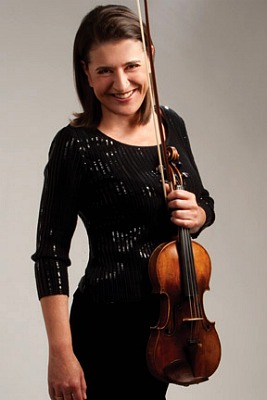
Nadja Salerno-Sonnenberg

By Andy Fein and Angie Newgren

Living the life of a performing violinist is (of course) a topic that captures all of us who play and listen to classical music. These virtuosos have a long list of accomplishments such as creating flawless repertoires, traveling across the world, winning competitions, judging competitions, starting foundations and much more. They are given (well deserved) instruments from various philanthopists and companies to perform their music, giving us the opportunity to hear the best from the best.
From our time comes a violinist who has mastered her playing, and also has one of the most interesting stories I've come across.

Nadja Salerno-Sonnenberg & her 1721 Petrus Guarnerius of Venice

Friday, January 6, 2012

Goffriller, Montagnana, and the Golden Age of Venetian Violin Makers

By Stefan Aune

In recent blogs we have focused on the city of Cremona, Italy, the renowned violin-making hub that gave us the names Amati, Stradivarius, and Guarnerius. While Cremona is certainly the nexus from which much of violin making history resonates, attention must also be paid to the city of Venice, renowned for its rich musical culture as well as its violin makers.

A Painting of the Venetian Canals by Joseph Turner
The political and economic context of Venice played a significant role in the development of its violin making culture. Venice was a "cultural crossroads" for commerce and art, with Saracens, Arabs, and Greeks rubbing shoulders with Europeans. The city was always staunchly independent from its European neighbors, hesitant to enter into long term alliances and agreements. The focus of Venetian politics was on propagating its trading culture, which flourished and made the city one of the mercantile centers of the world. Venice also maintained its independence from the Roman Catholic Church to such a degree that one of the popes excommunicated the entire city.  This was later reversed.

This independence resulted in two fundamental differences between the violin making cultures of Cremona and Venice. Whereas Cremona's fame derived from its provision of instruments to the courts of European royalty, Venetian makers made instruments for all classes of people, rich and poor alike. Additionally, the lack of church connections meant that Venice didn't benefit from the influences that spurred the development of the Cremonese violin designs. Consequently, the famous Venetian makers appear slightly after the rise of the Cremonese makers.

Thursday, December 29, 2011

Nicolo Amati, Violin Maker Extraordinaire & Teacher of the Greats

By Andy Fein,  Luthier at Fein Violins
and  Stefan Aune, with image research help by Elijah Fein

In The Amati Family of Violin Makers we introduced Andrea Amati and his sons Antonio and Hieronymus. These early makers established the Amati family and the city of Cremona, Italy as preeminate violin making institutions, and Hieronymus' fifth son, Nicolò, would build on this reputation and become the greatest maker of the Amati family, producing amazing instruments and training several of the most famous makers in history.

A violin by Nicolo Amati, Cremona,Itay, 1628

image from the National Music Museum


Friday, December 23, 2011

The Amati Family of Violin Makers. A Cremonese Dynasty

By Andy Fein, luthier at Fein Violins

1560 was a long time ago, even by violin standards where an instrument is "modern" until it's about one hundred years old. In an earlier post on the Oldest Known Violin Makers, we introduced Andrea Amati, the first recorded violin maker in Cremona, Italy. Andrea leased his first shop in Cremona in 1538, and his skills and those of his descendants produced a dynasty of violin makers of the Amati name and trained the Guarneris, Bergonzis, Rugeris and a fairly skilled violin maker named Antonius Stradivarius.

circa 1560 Andrea Amati Viola

image from the National Music Museum

The life of Andrea Amati goes so far back in history that it is difficult to pin down the exact timeline of his career. It is commonly held that Andrea learned under Gaspare da Salo in Brescia before setting up shop in Cremona, with the bulk of his work occurring in the second half of the16th century. However, in the Daniel Draley sponsored translation of Cremonese historian Carlo Bonnetti's La Genealogia degli Amati Liutai e il Primato della Scuola Liutistica Cremonese, there emerges a different story of Andrea's life. Carlo Bonnetti made use of documents produced by the Cremonese government, such as leases, marriage agreements, and contracts, to show that Andrea was established in Cremona far earlier in the 16th century, and that he was in fact much older than Gasparo da Salo. In a document from 1556 listing those Cremonese residents of the appropriate age to bear arms (15 - 50), we find Andrea's elder son, Antonio, but not Andrea himself. This would mean that Andrea was at least 50 years old in 1556, and this fact, combined with the fact that Gaspare de Salo was born in 1542, means that Andrea was about 40 years older than Gasparo and highly unlikely to have learned under him.

Sunday, December 4, 2011

Guarnerius del Gesu: Outlier Violin Maker

By Andy Fein, luthier at Fein Violins

In my earlier blog post, The Guarnerius Family of Violin Makers, we look at the history of the Guarnerius family, starting with Andreas Guarnerius. A couple of Pietros and a few Giuseppe's later, we arrive at Bartolomeo "Giuseppe" Guarnerius 'del Gesu'.

The 'del Gesu' was attached to his name, to distinguish him from his father, Giuseppe filius (son of) Andreas, and because 'del Gesu' put the initials "I.H.S." (a Latin abbreviation for Jesus' name) and a Christian Cross on all of his instruments' labels. He used 'Joseph,' the Latinization of 'Giuseppe,' on his labels.

del Gesu violin label
A label from a Joseph Guarnerius 'del Gesu' violin


Sunday, November 27, 2011

The Guarnerius Family of Violin Makers. Scions of Cremona

By Andy Fein, luthier at Fein Violins

We think of Cremona as the center of the world for violin making. After all, the greatest names in violin making worked there. Stradivarius, Guarnerius, Amati, Gudagnini, Bergonzi, and a few others. One of the earliest violin makers in Cremona was Andreas Guarnerius. A great violin maker and founder of a dynasty that would reach its apex in just two generations.

The scroll of the 'Primrose' Andreas Guarnerius viola of 1697

Wednesday, November 9, 2011

Chanot-Chardon: The Violin-Making Soap Opera Family

Written by Stefan Aune of Fein Violins

The Chanot-Chardon family of French and English violin makers trace their origins to Joseph Chanot, the first member of the family to add violin-maker as a profession. Joseph ran a small shop in Mirecourt, France, and the first violins that feature his label were produced in 1790. Joseph was a violin-maker, tradesman, and a farmer; a triple threat of vocations made necessary by his twelve children (that's quite a few mouths to feed). Two of Joseph's sons would follow in their father's footsteps and establish the Chanot name among the elite of French violin makers. The eldest, Francois, studied mathematics in Paris, graduating from the Ecole Polytechnique. He went on to specialize in the construction of naval war-ships, before taking an interest in violin making, albeit from a very scientific point of view. His thesis, titled (translated from French) "To Fix the Method a Violin Maker Must Use in the Workmanship of Stringed and Bowed Instruments" was accepted by a committee of experts and professional Alexandre Boucher played on the instrument built to Francois' specifications. Francois would go on to present a second thesis on instrument construction, and had the opportunity to present his research to the King of France during an exhibition. His forms were eventually taken up by the violin firm "Lete's Widow & Payonne," where they were used by the a young Jean Baptiste Vuillaume, who would go on to become an internationally renowned violin maker and a close friend of the Chanot family.

The Chanot shop in Paris
Picture from Parisian Violin Makers in the XIXth and XXth Centuries, Tome 1: The Family Chanot-Chardon by Sylvette Milliot
The youngest son, Georges, apprenticed with his father before joining Francois in the capital. He worked for a succession of Parisian makers before opening his own shop, founded in 1821. Georges was joined by his pupil Florentine Demolliens,  a 24 year old woman whose position as a violin maker caused a bit of a sensation, as women traditionally did not make violins at that point in history. Georges and Florentine eventually married, after having several children out of wed-lock, and the children were all legitimized together through baptism after the marriage. Wishing to get his name out there, Georges spent seven years traveling to Spain, Portugal, Germany, and England, and Russia, where he cultivated relationships with other makers and gained many international clients. His most notable customer was Tarisio, to whom he sold several highly skilled copies of Stradivarius and Guarnerius violins. In 1840, his wife and business partner Flornetine became ill, retiring to the countryside where she was cared for by her maid, Rose Chardon. Roses' sister, Antoineette Chardon, traveled to Paris to help Georges with the business. Their working relationship blossomed into some thing more, and Georges and Antoinette would eventually have a son together, Marie-Joseph Chardon. In the baptism act, Georges was named the godfather, and it wasn't until adulthood that Joseph learned that Georges was in fact his father. He would carry the family name Chardon, and pass it on to his children.

Thursday, November 3, 2011

Charlie Siem - Model Virtuoso Violinist

 Written by: Amy Tobin of Fein Violins

Charlie, Charlie, Charlie. Rarely has there been a violinist who not only plays so beautifully, but also looks so damn good.


Born in London, England, in 1986, Charlie Siem began studying the violin at the age of 4. He continued his studies at the Guildhall School of Music, and, later, at the Royal College of Music. He has soloed with orchestras that include the London Symphony Orchestra, the Royal Philharmonic, and the Israel Camerata. Meet Charlie......


He began studying the violin when, at the age of three, he heard the Beethoven Violin Concerto played, in concert, by violin great Yehudi Menuhin. Interestingly enough, he now plays on one of Menuhin's most beloved instruments.....his 1735 Guarneri del Gesu d'Egville. Sounds like a dream come true, to me!

Sunday, October 9, 2011

New or Old. Which is Better for Violins, Violas & Cellos?

Written by Andy Fein, Luthier at Fein Violins

I'm often asked: "Which is better? A new instrument or an old one?"

There is a mystique about old instruments. After all, Stradivarius & Guanerius were making instruments in the 1700s. Aren't all old instruments better than new ones? Well, yes and no. It depends on what you are interested in.

Stradivarius and Guarnerius made new instruments. Seems like a simple and intuitively obvious statement, but not everyone realizes that. Yes, Stradivarius, Amati, the Guarneris, Guadagnini, Montagnana, Vuillaume, Lupot, and the Chanot/Chardons were all real people. Real people making brand new instruments. Did they sound good when they were made? Probably, but we have no real way of knowing that. But judging from the people that played them and loved them, they were very nice sounding new instruments.

There were also a bunch of other makers from the 1500s on through the 1900s ( and even today)  that made passable, mediocre and downright lousy instruments. Are those old instruments better than a good sounding new instrument? Probably not.

Here are some considerations.

Monday, August 22, 2011

Chin Rests- Find The One That Fits Your Face!

Written by Andy Fein, luthier at Fein Violins
 and Angie Newgren

When purchasing a violin, usually you play on a few different instruments before choosing the correct one for you. The same can go for chin rests! There are many different structures of faces around the world so there are also different options for chin rests. You do not necessarily need to stick with the one that came with your violin. In fact, if the chin rest on your instrument is not comfortable, change it!

A tremendous variety of chin rests are made for violin and viola. Some hold your chin on the left of the instrument and some on the center. Some have deeper arcs, some are close to flat. You should choose your chin rest the same way you choose your instrument. Somehow, you need to fill the space between your chin and your shoulder. It's best to do it in the most comfortable way possible.

Friday, August 12, 2011

W.E. Hill & Sons - The Rise of England's Greatest Violin Firm

Written By Stefan Aune of Fein Violins

The Hill family of London is synonymous with high quality instruments, even higher quality bows, and for operating one of the most famous violin shops in the world. Particularly noted for being experts on the identification and restoration of older instruments, the Universal Dictionary of Violin & Bow Makers by William Henley calls the Hill guarantee "the most reliable in the entire world." The Hill family's roots go back hundreds of years in the history of English violin making, and they are one of the true institutions of the trade.

Most violin historians trace the family back to Joseph Hill, born in 1715. A well known and respected London maker, Joseph Hill had four violin-making sons, of whom Lockey Hill is considered the most distinguished. His son, Henry Lockey Hill, was the first Hill to adopt the Stradivarius model for his instruments, and to this day his instruments, particularly the cellos, remain some of the most valuable English instruments produced. His adaptation of the Stradivarius model raised the Hill family standard above that of general trade work and further engraved the Hill name into the annals of violin-making history. Henry Lockey Hill had five sons, and his fourth, William Ebsworth Hill, carried the family name even further when he founded the violin firm W.E. Hill & Sons in 1887 in London.

The bridge on the 'Lady Blunt' Stradivarius- W.E. Hill & Sons
(C) Tarisio 2011

Wednesday, August 10, 2011

Paganini's Violin: Il Cannone

Written by Andy Fein, luthier at Fein Violins
 and Angie Newgren, edited by Amy Tobin

There is a triangular relationship between a violinist, their instrument and their bow. Often times, we think of a certain "sound" when we think of a particular player. Much of that sound is defined by the instrument they play.

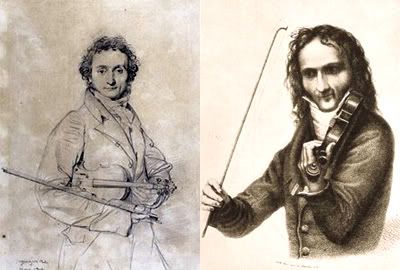
Niccolo Paganini & his  Guarnerius del Gesu violin,  "Il Cannone"

Paganini and his violin, a Guarnerius del Gesu named "Il Cannone" (the Cannon!), defined each other. Paganini was one of the first soloists to play a del Gesu. Its huge sound and fast response became Paganini's "sound". Made in 1742 (the Hills' attribution, others say 1743), late in del Gesu's life, the violin is preserved, as it was when Paganini played it, by the city of Genoa, Italy.

Sunday, August 7, 2011

Rachel Barton Pine. Violin Soloist. Head Banger.


Written by Andy Fein, luthier at Fein Violins
and Angela Newgren
Rachel Barton Pine. Concert violin soloist. Metal head. Head Banger. Baroque violinist. Electric violinist. The gal does it all.

Rachel Barton Pine

Talented on her instrument, playing solo performances, writing music and traveling across the globe to perform, Rachel Barton Pine's off-stage life remains just as accomplished. Whether she is teaching lessons, working at a summer camp for young musicians, promoting music education, or jammin' back stage with metal junkies, Rachel Barton Pine uses her talents to give back to the community.

Rachel Barton Pine started violin lessons at three years old.

Monday, July 25, 2011

Who Worked with Stradivarius?

Written by Andy Fein, luthier at Fein Violins

The romantic image of a lone violin maker, crafting each instrument individually from start to finish, is certainly an image that is held in high esteem. Something the British have termed "A One Off" - each instrument crafted from start to finish, varnished and set up by one individual.  But is it a true image of a violin workshop? Have instruments ever been made that way?

Sunday, July 17, 2011

Do You Hear What I Hear? Perceptions of Violin, Viola & Cello Tone

Written by Andy Fein, luthier at Fein Violins

Do you hear what I hear? The answer is -No. No one hears with your ears except yourself. Each of us has a different perception of hearing depending on our age and life experiences.

Doubt that? Take this amusing and not very scientific Mosquito Ringtone Hearing Test. It's very common for people over age 25 to not hear tones over 15kHz ( about 2 octaves above the highest note on a full size piano). Big deal, right? That high a note is very rarely, if ever, played in music. However, that note and even higher tones make up the overtones of many notes we play on stringed instruments. Those notes add to the "brightness" of an instrument in terms of tone quality. The more and higher the overtones, the brighter the instrument will sound. But only if you can hear those overtones. That's why an instrument might sound tinny and annoying to one person and pleasantly bright to another person.

If you're age 19 to 25 and are being smug about hearing things your elders can't, snap out of it. The high frequency hearing loss starts soon after age 18. Earlier and faster if you've listened to lots of loud noises (like loud concerts or ear buds pumped up high).

Sunday, July 3, 2011

Stradivarius vs. Guarnerius

Written By: Andy Fein, luthier at Fein Violins

In this corner... Antonius Stradivarius. Apprenticed to Amati at a young age, he was the first violin maker in his family. Stradivarius was a sober and industrious guy that led a large workshop cranking out his instruments for almost 60 years, from about 1680 to 1737. He made more than 2,000 instruments of which about 600 still exist, mainly violins, violas and cellos. If you know anything about violins or violin makers, you know the name Stradivarius.

In the opposite corner... Giuseppe Guarnerius, known as del Gesu.