Showing posts with label Vuillaume. Show all posts

Sunday, June 28, 2015

Your (Violin) Neck Used To Be Shorter

By Andy Fein, luthier at Fein Violins
 and Martha McDermott

Have you ever experienced this phenomena?- You or an orchestra friend gets some new string that's just hit the market, or a shoulder rest, or some other doodad AND it makes that violin sound GREAT! Next thing you know, every violinist in the orchestra has one! In the early nineteenth century there were huge changes going on in the violin world. First Paganini made some changes and it made his violin sound GREAT! Then next thing you knew, EVERYONE needed those changes.

It's hard to imagine an instrument as staid as the violin going through any evolutionary changes. Most of our modern violins are so standardized that if the string length is off by just a couple of millimeters, an experienced player will notice it. But early violins were not made to such standardized measurements. And one huge change that happened in the early 1800s is that the length of neck (and thus the string length) became longer! Almost no violins made before about 1830 retain their original necks. That includes Stradivaris, Guarneris, and Amatis.

Violino Piccolo in its Original Set Up by Girolamo Amati, Cremona, 1613 at the National Music Museum in Vermillion, South Dakota

Monday, February 3, 2014

Super Siblings: The other Vuillaume

by Andy Fein, luthier at Fein Violins
 and Joe Peterson


Nicolas Francois Vuillaume

With all of the news about Olympic super-siblings lately (there's 15 competing in Sochi 2014), we thought it would be interesting to take a look at Nicolas Francois Vuillaume, the younger brother of luthier, bow maker and dealer extraordinaire Jean Baptiste Vuillaume.

While searching for an instrument of the highest quality for the lowest amount of money, we rarely think to check out the siblings of the great makers. For instance, we all know about the maker who worked with Paganini and Sarasate, Jean Baptiste Vuillaume, "the French Stradivarius," but how many of us have heard about his brother Nicholas Francois?

Monday, February 6, 2012

Bernard Greenhouse and the auctioning of the Countess of Stainlein / Paganini Stradivarius Cello

By Stefan Aune

The famous "Countess of Stainlein, ex-Paganini of 1707" Stradivarius cello that was owned by the late Bernard Greenhouse has been sold at auction for more than $6 million to an anonymous patron of the arts in Montreal. This auction most likely sets a new record for the sale of a cello, the previous record being about $5 million. The cello, which was made by Stradivarius during his prolific "golden period," has been played on by Bernard Greenhouse since the 1950's. Greenhouse passed away in May of 2011, and his family arranged to sell his cello via sealed auction through Reuning & Sons Violins in Boston. The "anonymous patron" plans to loan the cello to 18 year old Stéphane Tétreault, a student studying cello and conducting at the University of Montreal.

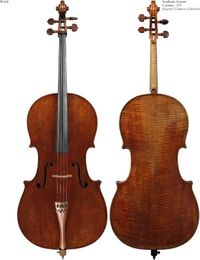
The Countess of Stainlein, ex-Paganini Stradivarius (allthingsstrings.com)


The Countess of Stainlein, Paganini Stradivarius cello, Cremona, 1707

Sunday, January 22, 2012

Mirecourt, France. Where the Seeds of French Bow Making Were Sown.

By Andy Fein and Angie Newgren

In the twenty-first century, violin makers (luthiers) and bow makers (archetiers) are usually two separate people with skill sets that are very rarely combined. It would seem that a luthier would be interested in making the bows that go with their instruments, but bow making is entirely its own occupation.

Violin bow attributed to Francois Jude Gaulard, Mirecourt, ca. 1845-1850

Mirecourt, France. Headwaters of French Violin Making

Written by Andy Fein, Violin Maker and Owner, Fein Violins, Ltd.

Many of France's best violin and bow makers from the 1700s to the present day share a very similar biography - Jacques (or Jean-Baptiste, Jeanne, Rene', Renee', Andre', Emile, etc.) were born in Mirecourt where they learned the trade from their father (or uncle, grandfather, brother,mother, sister, etc.). Starting at about age twelve, they worked at the bench with their family making instruments and bows... A shop owner in Paris (Vuillaume, Chanot, Caressa, Francais, etc.) heard of their talent and invited them to come to Paris. In Paris they received great acclaim for their work... Or didn't, so they slunk back to Mirecourt and toiled away in one of the production workshops there.

An H. Derazey violin, Mirecourt circa 1860

Wednesday, November 9, 2011

Chanot-Chardon: The Violin-Making Soap Opera Family

Written by Stefan Aune of Fein Violins

The Chanot-Chardon family of French and English violin makers trace their origins to Joseph Chanot, the first member of the family to add violin-maker as a profession. Joseph ran a small shop in Mirecourt, France, and the first violins that feature his label were produced in 1790. Joseph was a violin-maker, tradesman, and a farmer; a triple threat of vocations made necessary by his twelve children (that's quite a few mouths to feed). Two of Joseph's sons would follow in their father's footsteps and establish the Chanot name among the elite of French violin makers. The eldest, Francois, studied mathematics in Paris, graduating from the Ecole Polytechnique. He went on to specialize in the construction of naval war-ships, before taking an interest in violin making, albeit from a very scientific point of view. His thesis, titled (translated from French) "To Fix the Method a Violin Maker Must Use in the Workmanship of Stringed and Bowed Instruments" was accepted by a committee of experts and professional Alexandre Boucher played on the instrument built to Francois' specifications. Francois would go on to present a second thesis on instrument construction, and had the opportunity to present his research to the King of France during an exhibition. His forms were eventually taken up by the violin firm "Lete's Widow & Payonne," where they were used by the a young Jean Baptiste Vuillaume, who would go on to become an internationally renowned violin maker and a close friend of the Chanot family.

The Chanot shop in Paris
Picture from Parisian Violin Makers in the XIXth and XXth Centuries, Tome 1: The Family Chanot-Chardon by Sylvette Milliot
The youngest son, Georges, apprenticed with his father before joining Francois in the capital. He worked for a succession of Parisian makers before opening his own shop, founded in 1821. Georges was joined by his pupil Florentine Demolliens,  a 24 year old woman whose position as a violin maker caused a bit of a sensation, as women traditionally did not make violins at that point in history. Georges and Florentine eventually married, after having several children out of wed-lock, and the children were all legitimized together through baptism after the marriage. Wishing to get his name out there, Georges spent seven years traveling to Spain, Portugal, Germany, and England, and Russia, where he cultivated relationships with other makers and gained many international clients. His most notable customer was Tarisio, to whom he sold several highly skilled copies of Stradivarius and Guarnerius violins. In 1840, his wife and business partner Flornetine became ill, retiring to the countryside where she was cared for by her maid, Rose Chardon. Roses' sister, Antoineette Chardon, traveled to Paris to help Georges with the business. Their working relationship blossomed into some thing more, and Georges and Antoinette would eventually have a son together, Marie-Joseph Chardon. In the baptism act, Georges was named the godfather, and it wasn't until adulthood that Joseph learned that Georges was in fact his father. He would carry the family name Chardon, and pass it on to his children.

Wednesday, October 19, 2011

Pegs For Violins, Violas & Cellos- Ebony, Rosewood or Boxwood?

Written by Andy Fein, luthier at Fein Violins

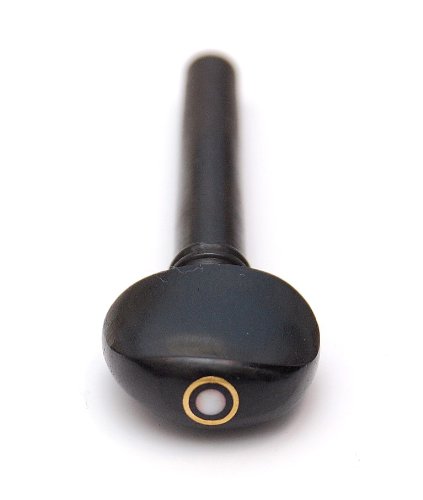
Violins4you Violin Peg Ebony One 1 With Pearl Dot Inlay / Parisian Eye
Ebony Violin Pegs with Parisian Eyes

Ebony, Rosewood or Boxwood. Those are usually the three choices of wood for pegs on stringed instruments. What's the difference? Probably not much beyond wood color and looks. But in stringed instruments, everything makes a difference. Considering that your pegs are the functioning unit on your instrument that enables you to tune, the pegs are very, very important.

Saturday, October 15, 2011

Hilary Hahn - Professional Violinist, Girl Next Door

Written by: Amy Tobin of Fein Violins

If there were such thing as a "young person's classical violinist," well, Hilary Hahn would definitely be that! In a time where the violin is getting more and more popular, by being used in more and more kinds of music, and yet less and less refined in its traditional sense, Hilary has managed to be able to combine both of those things. Firmly planted in the classical world, she wanders blissfully along the pathways of other artists and genres when the opportunity arises, never really leaving her ties to the classical world, but yet never really trying to be anything other than what she is when playing with others.


Monday, October 3, 2011

The Messiah Stradivarius

Written by Stefan Aune of Fein Violins

Antonius Stradivarius is easily the most renowned violin maker in history. His name has a magical quality that makes it recognizable to people who have never picked up an instrument or seen an orchestra perform. It is not uncommon to get a call here in the violin shop from someone who thinks they have found a "Stradivarius" in their basement and wants to know if they found the real deal. Although highly unlikely, turning up a genuine Stradivarius in your basement would be akin to winning the lottery - this past summer the Lady Blunt Stradivarius sold at auction for an astounding 16 million dollars. When it was auctioned the Lady Blunt was called "the best preserved Stradivarius to be offered for sale," and this was certainly true, but it isn't the best preserved Stradivarius in existence. That title belongs to the "Messiah" Stradivarius, which many people call "the consummate violin" for its astounding craftsmanship and perfect preservation.

File:Messiah Stradivarius.jpg
The Messiah Stradivarius of 1716


The Messiah was made by Antonius Stradivarius at his shop in Cremona, Italy in 1716. It remained, unsold, in the shop until Stradivarius' death in 1737. Stradivarius' son Paolo sold the Messiah to Count Cozio di Salabue in 1775, and famed collector Luigi Tarisio purchased the violin from the Count in 1827. Jean-Baptiste Vuillaume of Paris purchased the Messiah upon Tarisio's death, and the violin eventually made its way to the Ashmolean Museum of London where it remains to this day. As the Messiah passed from owner to owner, it remained relatively unplayed, which is why it is in such spectacular condition today.

Monday, August 15, 2011

Hill & Sons Violins. One-offs to Workshop

Written by Andy Fein, luthier at Fein Violins
and Stefan Aune


The Hill family of violin makers reaches deep into the history of violins. You can read our blog on the rise of the Hill firm to get a nice overview.

In the mid 1700's Joseph Hill was working at the Haymarket, in London, "at the sign of the Harp and Flute". He had a small shop at first and was probably working alone. Most of his instruments were made on a high arch model along the lines of Amati and Stainer. Joseph Hill's sons, William, Joseph, Benjamin, and Lockey all became violin makers as well. They continued with the high arched models that were popular at that time.

Lockey Hill's son, Henry Lockey, adopted the Stradivarius model and abandoned the higher arched models. For an individual maker, Henry Lockey is probably the finest maker of the Hill family and his instruments are some of the most valuable English instruments.

Wednesday, August 10, 2011

Paganini's Violin: Il Cannone

Written by Andy Fein, luthier at Fein Violins
 and Angie Newgren, edited by Amy Tobin

There is a triangular relationship between a violinist, their instrument and their bow. Often times, we think of a certain "sound" when we think of a particular player. Much of that sound is defined by the instrument they play.

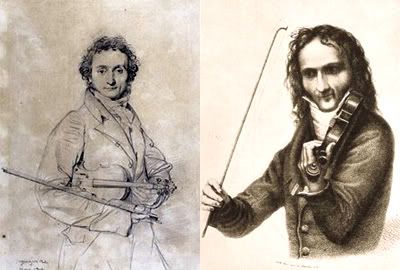
Niccolo Paganini & his  Guarnerius del Gesu violin,  "Il Cannone"

Paganini and his violin, a Guarnerius del Gesu named "Il Cannone" (the Cannon!), defined each other. Paganini was one of the first soloists to play a del Gesu. Its huge sound and fast response became Paganini's "sound". Made in 1742 (the Hills' attribution, others say 1743), late in del Gesu's life, the violin is preserved, as it was when Paganini played it, by the city of Genoa, Italy.

Sunday, July 31, 2011

Jean-Baptiste Vuillaume. Luthier, Bow Maker & Dealer Extraordinaire

By Fein Violin Staff

Jean-Baptiste Vuillaume is an extremely important figure in the world of violins. Vuillaume had a shop in Paris from 1822 until his death in 1875. He was admired by and friends with Paganini, Ole Bull, and a host of other great soloists.

Label of an 1841 Jean-Baptiste Vuillaume cello

He was three steps removed from Stradivarius' workshop. After Antonius Stradivarius died, his entire workshop and remaining instruments were purchased by Count Cozio. Luigi Tarisio, an itinerant violin dealer purchased many instruments from Count Cozio and brought them to Paris. Vuillaume purchased many Stradivarius instruments from Tarisio. When Tarisio died, Vuillaume traveled directly to Italy to purchase his remaining collection of Stradivarius instruments. And other Cremonese instruments as well. Guaneris, Amatis, Bergonzis, Ruggieris, Rogeris and many more. Just about every Stradivarius and Guarnerius del Gesu passed through Vuillaume's shop at some point.

Monday, July 25, 2011

Who Worked with Stradivarius?

Written by Andy Fein, luthier at Fein Violins

The romantic image of a lone violin maker, crafting each instrument individually from start to finish, is certainly an image that is held in high esteem. Something the British have termed "A One Off" - each instrument crafted from start to finish, varnished and set up by one individual.  But is it a true image of a violin workshop? Have instruments ever been made that way?

Sunday, July 24, 2011

Comparing Two Stradivarius Violins - The 'Lady Blunt' and the 'Messiah'.

Written by Andy Fein, luthier at Fein Violins

On June 10, 2011, the two finest Stradivarius violins in the world were displayed side by side at the Ashomolean Museum in Oxford, England. The Ashmolean is home to the most perfectly preserved Stradivarius in existence, the 'Messiah' of 1716. The Lady Blunt of 1721 would certainly be considered the next most perfect Stradivarius next to the 'Messiah'. The strange difference is that it is almost universally accepted that the 'Lady Blunt' is a Stradivarius. Not so with the 'Messiah'.

'The Messiah' on display at the Ashmolean Museum

© Pruneau / Wikimedia Commons
'Lady Blunt' Stradivarius

Tarisio Auctions. Violachick68 at English Wikipedia

The Messiah Stradivarius has an interesting history. Made in 1716, the 'Messiah' violin remained unused in the Stradivarius workshop until the death of Antonius Stradivarius in 1737. Still unused and unplayed, the 'Messiah' violin was sold by Antonius’ son Paolo to Count Cozio di Salabue in 1775. Luigi Tarisio purchased the Messiah Stradivarius violin from Count Cozio in 1827. Jean-Baptiste Vuillaume of Paris purchased the Messiah Stradivarius violin, and the rest of Tarisio’s collection, upon Tarisio’s death in 1854. Eventually the Messiah Stradivarius made its way to the Hill shop of London and the Ashmolean Museum in Oxford, England. For most of its life, the 'Messiah' has remained unplayed! 

Since it was not sold by Stradivarius nor played in his lifetime, and not played by any of the other owners, it is perfectly preserved. Many critics have argued that it is too perfectly preserved. That is, it is so perfect that it cannot be a Stradivarius. One of the more common theories is that it is actually a very perfectly made copy of a Stradivarius, probably made by Vuillaume and his workshop. 

The 'Lady Blunt' is on the bottom, the 'Messiah' is in the middle, the 'Hellier' on top.
Bringing two Stradivarius violins side by side allowed for great comparative observation and photographic documentation.
The 'Lady Blunt is on the left, the 'Messiah' on the right.

The conclusion? They are very similar instruments. If an expert would accept the 'Lady Blunt' as a Stradivarius (an almost universal truth!) then any reasonable expert would have to accept the 'Messiah" as a Stradivarius as well. 

We blogged about the 'Lady Blunt' previously. There are more pictures there as well. 

It might be heresy to preservationists, but I argue that all violins, even the 'Messiah' and the 'Lady Blunt,' should be played. They were made to be musical instruments, not objets d'art! When they are not played, they are more than half dead. Play them!
The 'Messiah is on the left, the 'Lady Blunt' on the right.
Many thanks to the Ashmolean Museum and Tarisio Auctions for making the display possible!

We have two violins modeled after the 'Lady Blunt' Stradivarius - Fein 'Lady Blunt' Stradivarius model and the Cremone DIVA Violin. We also have the A. Fein Patrizio Stradivari Violin which has features of both the 'Messiah' and 'Lady Blunt'.